

In today’s industrial manufacturing environment, traceability is no longer just an identification requirement—it is a critical production control system.
From automotive parts to industrial tooling and precision metal components, manufacturers rely on fiber laser marking systems to ensure every part can be uniquely identified, tracked, and verified throughout its entire lifecycle.
Fiber laser marking has become the global standard for metal traceability because it provides:
- Permanent, wear-resistant marking on metal surfaces
- High-speed integration with automated production lines
- Machine-readable QR code and Data Matrix support
- Stable performance across industrial environments
This guide explains how fiber laser marking is used in real manufacturing systems—not theory, but engineering-driven application logic.
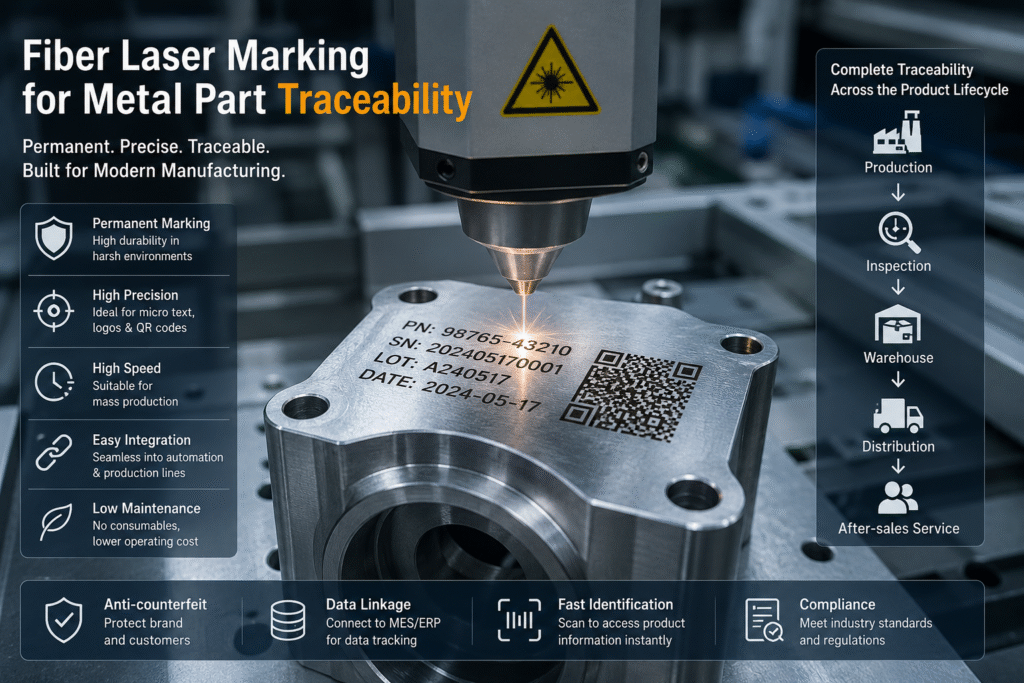
1. What is metal part traceability in manufacturing?
Metal part traceability refers to the ability to track a component across its entire lifecycle:
- Raw material sourcing
- Production and machining
- Quality inspection
- Assembly and distribution
- After-sales and warranty service
Each part must carry a unique identifier that remains readable even after years of industrial use.
👉 This is where fiber laser marking becomes essential.
2. Why traditional marking systems fail in real factories
Before laser marking, manufacturers used ink printing, labels, or mechanical stamping. These systems fail under industrial conditions.
Common failure points:
- Ink fades after heat treatment or cleaning
- Labels detach due to oil, vibration, or friction
- Mechanical stamping damages precision parts
- Low-density codes cannot support digital traceability
Engineering conclusion:
Traditional marking methods cannot support modern digital manufacturing systems (MES/ERP integration).
3. Why fiber laser marking is the industrial standard
Fiber laser marking uses a high-energy laser beam to permanently modify the surface of metal materials without consumables.
Key engineering advantages:
- Non-contact process (no tool wear)
- Permanent marking (no fading or peeling)
- Micro-level precision (supports QR/Data Matrix)
- High-speed operation (suitable for automation)
- Low maintenance cost
👉 This makes it ideal for high-volume manufacturing environments.
4. What manufacturers mark for traceability systems
Industrial traceability is structured—not random marking.
Level 1: Product identification
- Serial number
- Part number
- Batch code
Level 2: Manufacturing data
- Production date/time
- Machine ID
- Operator ID
Level 3: Digital traceability
- QR code linked to ERP system
- Inspection report reference
- Quality control status
Level 4: Supply chain tracking
- OEM supplier ID
- Export batch tracking
- Warranty validation code
5. Real production workflow (factory-level implementation)
Fiber laser marking is integrated into automated production systems.
Standard workflow:
- CNC machining / casting completed
- Part transferred to marking station
- MES system generates traceability ID
- Fiber laser marks QR code or serial number
- Vision system verifies readability
- Data uploaded to database
- Part proceeds to assembly or packaging
Engineering insight:
Cycle time typically ranges from 0.5 to 3 seconds per mark, depending on code complexity.
6. Material behavior in fiber laser marking
Different metals respond differently to laser energy.
Stainless steel
- High contrast annealed marking
- Excellent QR readability
- Widely used in industrial parts
Aluminum
- Requires precise energy control
- Risk of overburn if parameters are incorrect
- Common in electronics and aerospace
Carbon steel
- Supports deep engraving
- High durability under mechanical stress
Brass / copper
- High reflectivity
- Requires optimized frequency and power settings
👉 Marking quality depends heavily on parameter tuning, not just machine power.
7. Fiber laser vs other marking technologies
Inkjet systems
- Consumable-dependent
- Low durability
- Not suitable for harsh environments
Dot peen systems
- Physical deformation required
- Limited micro-code capability
- Slower for automation
Mechanical engraving
- High tool wear
- Not suitable for high-speed production
Fiber laser marking
- Permanent + non-contact
- High-speed + high precision
- Fully automation-ready
8. Why traceability is now a supply chain system
Modern manufacturing uses traceability for more than identification.
Key system functions:
Anti-counterfeiting
Each part has a unique digital identity linked to a database.
Warranty validation
End users can verify authenticity via QR scan.
Recall management
Manufacturers can isolate defective batches precisely.
OEM compliance
Ensures regulatory and contractual traceability requirements.
9. How engineers select a fiber laser marking system
Machine selection is always application-driven.
Key evaluation factors:
- Material type (steel, aluminum, copper, coated surfaces)
- Marking content complexity (serial vs QR code)
- Production speed requirements
- Automation integration (robot/PLC/MES)
- Readability under real lighting conditions
👉 Sample testing is always required before production deployment.
10. Application scenarios (industry-specific use cases)
Automotive industry
- VIN marking
- Engine component traceability
- Heat-resistant marking requirements
Industrial tooling
- Tool ID tracking
- Lifecycle usage management
Electronics manufacturing
- PCB and housing traceability
- High-density QR coding
Aerospace industry
- Full lifecycle compliance tracking
- Strict inspection documentation linkage
If you are planning to implement a fiber laser marking system for metal part traceability, the key is not only choosing the machine—but ensuring it matches your material, marking content, and production workflow.
👉 Contact our engineering team to evaluate your application and get a tailored marking solution for your production line.
11. FAQ
1. What metals can fiber laser marking work on?
It works on stainless steel, carbon steel, aluminum, brass, copper, and coated metals.
2. Is fiber laser marking permanent?
Yes, it creates permanent marks that do not fade or wear off.
3. Can fiber laser mark QR codes?
Yes, it supports high-density QR codes and Data Matrix codes.
4. Does laser marking damage the material?
No, it is a non-contact process with controlled surface modification.
5. How fast is fiber laser marking?
Typically 0.5–3 seconds per mark depending on complexity.