

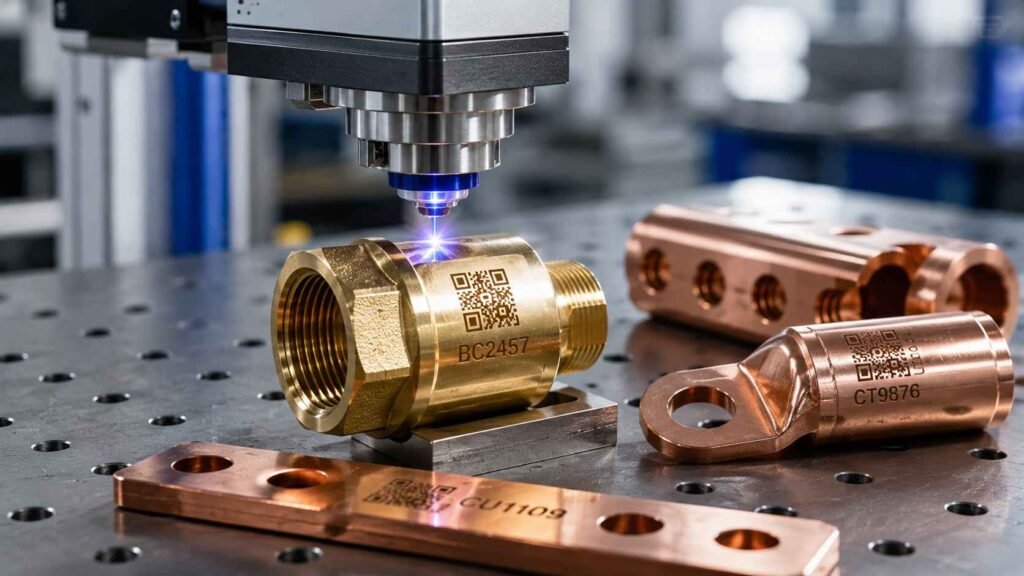
Brass fittings, copper terminals, aluminum housings, and other reflective metal parts are widely used in electrical, hardware, automotive, plumbing, electronics, and precision manufacturing industries. These parts often need permanent logos, serial numbers, QR codes, batch codes, or traceability marks. Fiber laser marking is one of the most common methods for this work, but reflective metals require more careful testing than ordinary steel.
Brass and copper can be marked by fiber laser. The challenge is not whether the laser can leave a visible mark, but whether the mark can remain clear, readable, stable, and repeatable in real production. Material reflectivity, heat conductivity, surface finish, laser power, focus accuracy, and marking parameters all affect the final result.
For buyers, the right way to evaluate fiber laser marking brass, laser marking copper, and other reflective metal applications is to look at the actual marking requirement: surface marking, dark marking, deep engraving, QR code readability, production speed, and long-term durability.
Why Reflective Metals Are Different from Ordinary Steel
Materials such as brass, copper, aluminum, bronze, silver, gold, and polished alloys reflect more laser energy than many common industrial steels. They also transfer heat quickly. This means the laser energy must be controlled more precisely to create a stable mark.
Three factors are especially important:
- Reflectivity: Part of the laser energy may reflect away from the surface instead of being absorbed.
- Thermal conductivity: Copper and aluminum conduct heat quickly, which can reduce contrast or make the mark less stable.
- Surface condition: Polishing, plating, oxidation, oil, coating, and protective film can all change the marking result.
This is why two parts with the same material name may not mark the same way. A polished brass valve, a brushed brass plate, a plated connector, and an oxidized copper terminal may all need different laser settings.
Can Fiber Laser Mark Brass?
Brass is one of the more practical reflective metals for fiber laser marking. Because brass is usually an alloy of copper and zinc, it is often easier to mark than pure copper. With suitable parameters, a fiber laser can create clear text, logos, serial numbers, QR codes, scale lines, and decorative patterns on brass surfaces.
Common brass marking applications include:
- Brass valves and plumbing fittings
- Electrical terminals and connectors
- Locks, hinges, handles, and hardware accessories
- Brass nameplates, tags, and identification plates
- Jewelry, medals, trophies, and decorative products
- Precision-machined brass components
For light surface marking on brass, a 20W or 30W fiber laser may be enough in many cases. For stronger contrast, deeper engraving, larger marking areas, or faster production, buyers usually evaluate 50W or higher configurations. The final choice should be based on sample testing, not only on the material name.
Can Fiber Laser Mark Copper?
Copper can also be marked by fiber laser, but it is usually more demanding than brass. Pure copper has high reflectivity and excellent heat conductivity, so it absorbs laser energy less efficiently and spreads heat faster across the surface.
Typical copper marking applications include:
- Copper busbars
- Electrical conductive parts
- Copper terminals and connectors
- Battery components and new energy parts
- Copper pipes and HVAC fittings
- Decorative copper plates and custom metal tags
For copper parts, buyers should define the required effect clearly before choosing the machine. A simple part number, a dark logo, a deep engraved mark, and a scannable QR code are different tasks. They may require different power levels, speeds, frequencies, focus positions, and marking passes.
A Practical Way to Test Brass and Copper Marking
In a real production evaluation, a buyer may need to mark both brass fittings and copper terminals. The brass fitting may require a brand logo and batch number on a polished surface. The copper terminal may require a small serial number and QR code for traceability.
During testing, the brass part may produce a clear visible mark with moderate power and adjusted speed. The copper part may need slower marking speed, more accurate focus, and several parameter groups before the code becomes stable enough for scanning. This difference is normal when comparing brass laser marking with copper laser marking.
A professional sample test should check more than the appearance of the mark. It should confirm:
- Whether the mark is readable under normal factory lighting
- Whether QR codes or Data Matrix codes can be scanned reliably
- Whether the mark remains stable after handling, rubbing, or cleaning
- Whether the cycle time meets production requirements
- Whether the part surface has unacceptable heat marks, rough edges, or discoloration
What Marking Effects Are Possible?
Fiber laser can produce different effects on brass, copper, aluminum, and other reflective metals. The right effect depends on the material, surface finish, and production requirement.
| Marking Requirement | Typical Result | Buyer Check |
|---|---|---|
| Logo marking | Brand mark or decorative pattern | Check contrast on the actual surface finish |
| Serial number marking | Permanent product identification | Confirm font size, readability, and speed |
| QR code marking | Traceability code for scanning systems | Test with real scanners after marking |
| Deep engraving | Recessed mark on the metal surface | Confirm depth, edge quality, and cycle time |
| Dark marking | Higher contrast surface effect | Requires careful pulse, speed, and frequency adjustment |
| Fine text marking | Small characters on compact parts | Check lens field size and focusing accuracy |
For traceability applications, the visual mark is not enough. QR codes and serial numbers should be tested with actual scanning equipment. For more details on this type of application, see how to mark QR codes and serial numbers on metal parts.
Which Reflective Metals Can Be Marked by Fiber Laser?
A fiber laser marking machine for metal parts can mark many reflective and semi-reflective materials, but each material responds differently to laser energy.
| Material | Marking Difficulty | Common Applications | Buyer Notes |
|---|---|---|---|
| Brass | Medium | Valves, fittings, nameplates, hardware, gifts | Usually easier than pure copper; polished surfaces need testing |
| Copper | High | Busbars, terminals, connectors, pipes, battery parts | High reflectivity and heat conductivity require optimized settings |
| Aluminum | Medium | Auto parts, electronics housings, tools, nameplates | Anodized and raw aluminum produce different results |
| Bronze | Medium | Decorative parts, plaques, mechanical components | Alloy composition affects contrast and speed |
| Silver and Gold | Medium to High | Jewelry, tags, luxury accessories | Fine detail is possible, but heat control is important |
| Titanium | Low to Medium | Medical parts, tools, aerospace parts | Can produce clear marks with suitable parameters |
What Laser Power Is Suitable for Brass and Copper?
There is no single laser power that fits every brass or copper application. The correct choice depends on marking depth, contrast, material thickness, cycle time, production volume, and whether the mark includes QR codes or fine text.
| Laser Power | Suitable Use | Typical Buyer Scenario |
|---|---|---|
| 20W | Light marking and small text | Small brass tags, simple logos, basic part numbers |
| 30W | General industrial marking | Logos, serial numbers, and QR codes on brass, aluminum, and steel parts |
| 50W | Stronger contrast and faster production | Brass and copper parts requiring better productivity or moderate engraving |
| 100W | Deeper engraving and high throughput | Industrial production where speed and engraving depth are important |
For reflective metals, buyers should not choose a machine only by price. A lower-power machine may mark a sample slowly, but fail to meet production speed. A higher-power machine may improve efficiency, but it still needs correct parameters to avoid rough edges, excessive heat, or poor contrast.
When the same workshop marks different types of metal parts, it is better to evaluate the full fiber laser marking machine configuration, including laser power, lens field size, fixture design, and marking software workflow.
Key Parameters That Affect Brass and Copper Laser Marking
Small parameter changes can create a large difference in marking quality. For brass, copper, and other reflective metals, the following settings should be tested carefully:
- Laser power: Higher power can improve depth and speed, but excessive power may cause rough edges or heat discoloration.
- Marking speed: Slower speed increases energy per area, but may reduce production efficiency.
- Frequency: Frequency affects heat accumulation, surface texture, and contrast.
- Pulse width: Proper pulse control can help improve dark marking or reduce surface damage in some applications.
- Focus position: Accurate focus is critical for fine text, QR codes, and small components.
- Line spacing: Hatch spacing affects coverage, smoothness, and marking density.
- Lens field size: A smaller field can improve fine detail, while a larger field is useful for bigger parts.
- Number of passes: Multiple passes can increase depth, but may also increase heat and cycle time.
This is why buyers should ask for parameter testing instead of only asking whether the machine can mark copper or brass. The final parameter window determines whether the result is stable in production.
Surface Preparation Is Important
Surface condition has a direct influence on laser marking reflective metals. Oil, fingerprints, polishing compound, oxidation, plating residue, dust, and protective film may all affect the final result.
Before sample testing, the part surface should be prepared in the same way as real production parts. Testing on a clean flat brass sheet cannot fully represent marking on a polished valve, curved fitting, plated connector, or copper busbar.
For better repeatability, buyers should confirm:
- Whether the production part is raw, polished, brushed, plated, coated, or oxidized
- Whether the surface condition changes between batches
- Whether the part needs cleaning before marking
- Whether the mark must resist rubbing, oil, cleaning, or outdoor exposure
How to Choose a Fiber Laser Marking Machine for Reflective Metals
Machine selection should not be based only on laser power. For brass, copper, and other reflective metals, the complete system matters: laser source, scanner, lens, control software, fixture, focusing method, and supplier testing experience.
Important selection points include:
- Material range: Confirm whether the machine will mark brass, copper, aluminum, stainless steel, titanium, or mixed materials.
- Required marking effect: Define whether you need surface marking, dark marking, deep engraving, or QR code marking.
- Production volume: Occasional marking and continuous batch production require different configurations.
- Part size and shape: Flat plates, round pipes, valves, terminals, and large components require different positioning methods.
- Code readability: QR codes and Data Matrix codes should be verified with real scanning equipment.
- Operator workflow: The machine should be easy to focus, position, edit, and repeat in daily operation.
If the parts are large, heavy, or difficult to move, a portable laser marking machine may be more practical for on-site marking, large metal components, molds, pipes, or maintenance workshops.
Sample Testing Before Ordering
For brass, copper, aluminum, and other reflective metals, sample testing is strongly recommended before machine confirmation. A professional sample test should not only show a good-looking mark. It should confirm whether the result can meet production requirements.
Before sending samples, buyers should prepare the following information:
- Material type and alloy grade, if available
- Surface condition, such as polished, brushed, plated, coated, raw, or oxidized
- Part photos, drawings, or dimensions
- Marking content, such as logo, serial number, QR code, or batch code
- Required marking size and position
- Target cycle time per part
- Required marking depth or contrast
- Whether the mark needs to pass rubbing, oil, cleaning, or corrosion tests
- Whether the part will be marked manually, in batches, or on a production line
This information helps the supplier recommend a more accurate machine configuration. It also reduces the risk of buying a machine that can mark a sample but cannot meet real production speed or quality requirements.
Common Problems When Marking Reflective Metals
| Problem | Possible Cause | Recommended Check |
|---|---|---|
| Mark is too light | High reflectivity, high speed, poor focus, or insufficient energy | Adjust speed, power, frequency, focus, and number of passes |
| QR code is visible but not scannable | Low contrast, wrong cell size, curved surface, or rough texture | Test with real scanner and optimize code size and contrast |
| Edges look rough | Excessive heat, incorrect hatch spacing, or too many passes | Reduce heat accumulation and adjust line spacing |
| Result changes between batches | Different alloy composition or surface finish | Standardize material source and surface preparation |
| Surface is overheated | Too much energy or slow marking speed | Reduce power, increase speed, or change parameter group |
When Fiber Laser May Not Be the Best Choice
Fiber laser is suitable for many metal marking applications, but it is not always the best choice for every material or every marking effect. If the buyer needs very low-heat marking, high-contrast marking on certain plastics, or special marking effects on sensitive surfaces, other laser types may need to be compared.
For buyers comparing different laser options for metal parts, this article on fiber vs UV laser marking for metal parts may be useful.
Buyer Checklist Before Confirming a Machine
Before ordering a fiber laser marking machine for brass, copper, or other reflective metals, confirm these points:
- What exact metal or alloy will be marked?
- Is the surface raw, polished, brushed, plated, coated, or oxidized?
- Do you need light marking, dark marking, deep engraving, or code marking?
- What is the required marking area and character size?
- Will the mark include QR codes, Data Matrix codes, or serial numbers?
- What is the target marking speed per part?
- Will parts be marked one by one, in batches, or on an automated line?
- Do you need a desktop machine, enclosed workstation, or portable laser marker?
- Can real samples be tested before final confirmation?
Conclusion
Fiber laser can mark brass, copper, aluminum, bronze, and many other reflective metals. Brass is usually easier to mark than pure copper, while copper often requires more careful power control, focus accuracy, and parameter testing.
For buyers, the most reliable approach is to define the required marking effect first, then test real production samples. A qualified marking result should provide not only a visible mark, but also stable contrast, readable codes, repeatable quality, and practical production efficiency.
If you need to evaluate brass fittings, copper busbars, terminals, aluminum housings, nameplates, hardware parts, tools, or other reflective metal components, prepare the material type, surface photo, marking file, required mark size, and target cycle time before sample testing. These details make it much easier to confirm the right laser marking configuration.
FAQ: Fiber Laser Marking on Brass, Copper, and Reflective Metals
Can a fiber laser mark brass?
Yes. Fiber laser can mark brass logos, serial numbers, QR codes, scale lines, and product information. The final result depends on the brass surface, laser power, marking speed, and required contrast.
Can a fiber laser mark copper?
Yes, but copper is more difficult to mark than many other metals because it reflects laser energy and conducts heat quickly. Real sample testing is recommended before machine confirmation.
What power is better for brass and copper laser marking?
20W or 30W may be suitable for light marking on many brass parts. For copper, deeper engraving, faster production, or stronger contrast, 50W or higher configurations may be considered after sample testing.
Can fiber laser make black marks on copper?
In some cases, fiber laser can create dark or high-contrast marks on copper, but the result depends on copper grade, surface condition, pulse control, and parameter settings. The final effect should be confirmed by testing real parts.