

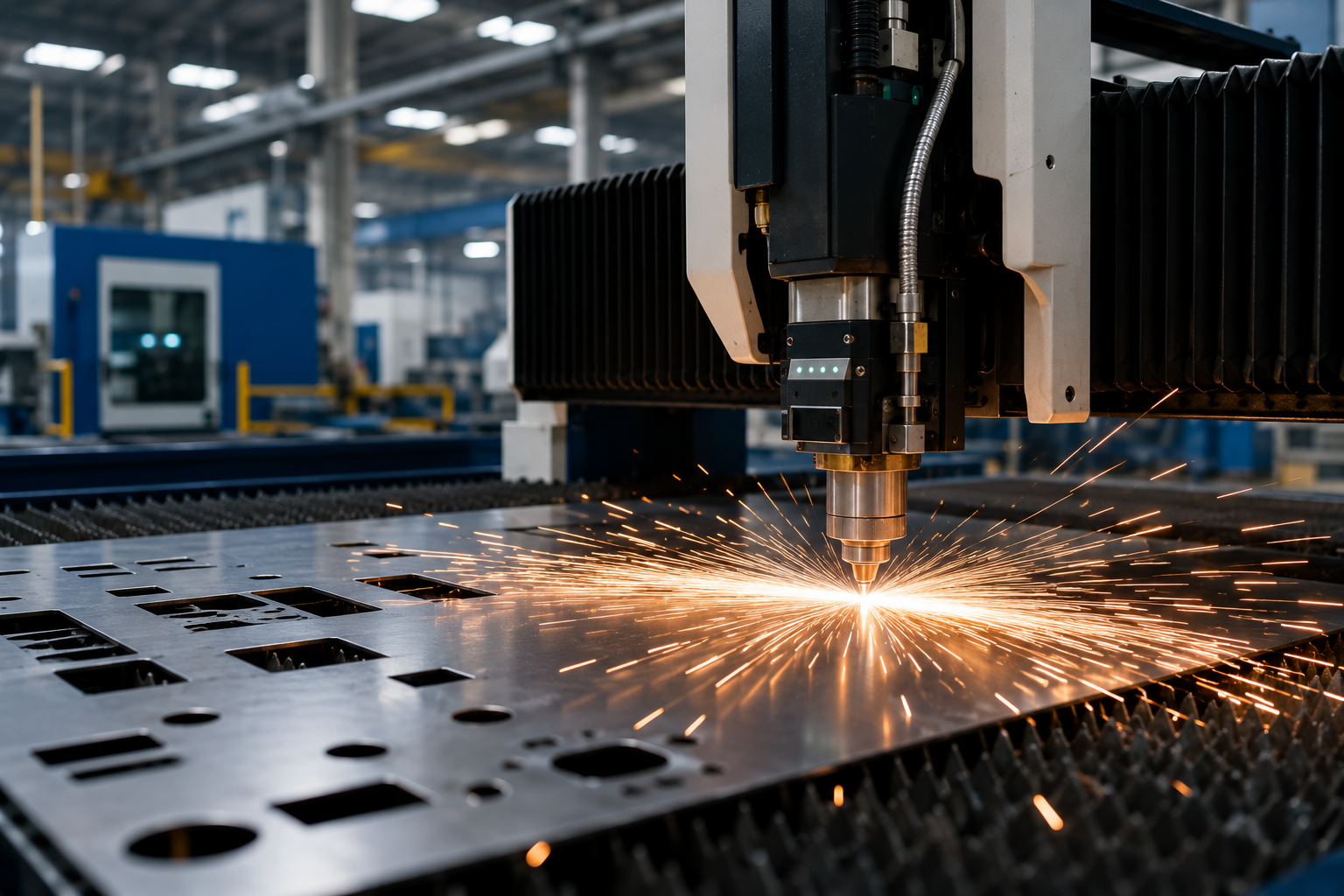
Choosing the right fiber laser cutting machine is not only about comparing laser power or machine price. For sheet metal manufacturers, the correct choice depends on material type, sheet thickness, production volume, workshop space, cutting quality requirements, site conditions and long-term service support.
A well-selected fiber laser cutting machine can help improve cutting speed, reduce material waste, lower labor cost and support stable production. However, choosing the wrong machine may lead to poor cutting quality, unnecessary investment, difficult maintenance or limited production capacity.
This guide explains how to choose a suitable laser cutting machine for sheet metal from a practical buyer’s perspective.
What Is a Fiber Laser Cutting Machine?
A fiber laser cutting machine uses a high-energy laser beam to cut metal sheets with high precision. The laser beam is focused on the material surface, melting or vaporizing the cutting area while auxiliary gas removes molten material from the kerf.
Compared with traditional cutting methods, fiber laser cutting is widely used because it offers narrow cutting seams, fast processing speed, high precision, low deformation and strong flexibility for different metal materials.
For many workshops, a laser cutting machine is used for daily sheet metal processing, electrical cabinets, metal enclosures, hardware parts, decorative panels, machinery components and industrial manufacturing applications.
Why Choosing the Right Machine Matters
Many buyers first ask: “What laser power should I choose?” This is important, but it is not the only factor.
A fiber laser cutting machine is a complete production system. The final cutting performance depends on the laser source, cutting head, machine bed, control system, worktable design, auxiliary gas, workshop environment and operator skill.
If the machine does not match your real production needs, several problems may appear:
- The machine cannot cut your required thickness efficiently.
- The cutting edge quality is unstable.
- The machine occupies too much workshop space.
- Loading and unloading reduce production efficiency.
- Maintenance becomes difficult or expensive.
- The initial investment is higher than necessary.
- The supplier cannot provide proper support after delivery.
That is why buyers should evaluate both technical requirements and business needs before purchasing.
Step 1: Confirm Your Material Type
The first step is to confirm what materials you need to cut. Different metals have different laser absorption, reflectivity, cutting speed and gas requirements.
Common materials for fiber laser cutting include:
- Carbon steel
- Stainless steel
- Aluminum
- Galvanized sheet
- Brass
- Other suitable metal sheets depending on machine configuration
For example, carbon steel is commonly used in machinery, steel structures and general fabrication. Stainless steel is common in kitchen equipment, decoration, cabinets and precision sheet metal products. Aluminum is widely used in lightweight structures, transportation parts and some industrial components.
If your workshop processes reflective materials such as aluminum or brass, you should pay attention to machine protection, cutting head configuration and supplier experience. Reflective materials usually require more careful parameter matching and stable machine performance.
Step 2: Confirm Your Sheet Thickness Range
Material thickness is one of the most important factors when choosing a fiber laser cutting machine. A machine that is suitable for thin sheet cutting may not be the best choice for thicker plates. A high-power machine may also be unnecessary if your work mainly involves thin stainless steel or thin carbon steel sheets.
Before asking for a quotation, prepare a clear thickness list:
- Minimum sheet thickness
- Most common thickness
- Maximum thickness
- Material type for each thickness
- Expected cutting edge quality
- Daily cutting quantity
For example, a buyer who mainly cuts thin stainless steel panels may need a different solution from a buyer who frequently cuts thicker carbon steel plates. The right choice should be based on your actual production ratio, not only the maximum thickness you may occasionally process.
Step 3: Choose the Right Worktable Design
Worktable design affects productivity, floor space, loading efficiency and investment cost. MADE Laser provides different laser cutting machine options for different production needs, including single table fiber laser cutting machines, double worktable laser cutting machines and dual worktable enclosed laser cutting machines.
Single Table Fiber Laser Cutting Machine
A single table fiber laser cutting machine is suitable for buyers who need a practical, cost-effective and space-saving metal sheet cutting solution.
It is often a good choice when:
- Workshop space is limited.
- The buyer is purchasing a laser cutter for the first time.
- Production volume is stable but not extremely high.
- Budget control is important.
- Simple operation and easier maintenance are preferred.
For small and medium workshops, a single table model can provide a good balance between cutting performance, investment cost and operational simplicity.
Double Worktable Laser Cutting Machine
A double worktable laser cutting machine is designed for higher productivity. While one table is cutting, the other table can be used for loading and unloading materials.
This design helps reduce waiting time and improves production efficiency. It is suitable for factories with higher cutting volume, continuous production needs and stronger delivery pressure.
You may consider a double worktable model if:
- You need faster material loading and unloading.
- Your factory cuts metal sheets for many hours every day.
- Production efficiency is more important than minimum investment.
- You want to reduce downtime between cutting tasks.
- Your order volume is increasing.
Dual Worktable Enclosed Laser Cutting Machine
A dual worktable enclosed laser cutting machine is usually more suitable for buyers who care about safety, dust control, professional workshop appearance and higher production standards.
The enclosed structure can help create a cleaner and safer operating environment, especially when the machine is used in a modern factory or high-standard production workshop.
This type of machine is often suitable for:
- Medium and large manufacturing factories
- Workshops with higher safety requirements
- Factories that need a more professional production environment
- Users with continuous sheet metal cutting demand
- Buyers who want better protection around the cutting area
Step 4: Evaluate Cutting Quality Requirements
Not every buyer has the same cutting quality requirement. Some parts only need rough cutting before welding or bending. Other parts require clean edges, high precision and better appearance.
Before selecting a machine, consider these questions:
- Do your parts require high dimensional accuracy?
- Is the cutting edge visible in the final product?
- Will the parts be painted, polished or welded later?
- Do you need to reduce burrs?
- Do you need stable quality for repeated batch production?
- Are your parts used in precision assemblies?
If cutting quality is very important, you should not only compare laser power. You also need to consider machine bed stability, motion system, cutting head performance, control system and supplier parameter experience.
Step 5: Consider Production Volume and Workflow
Production volume is a key factor in machine selection. A small workshop and a large metal fabrication factory may need completely different machine configurations.
If your production volume is low to medium, a single table model may be enough. If you need continuous production, a double worktable or enclosed dual worktable machine may be more suitable.
You should estimate:
- How many hours the machine will work per day
- How many sheets you need to process per shift
- Whether loading and unloading will become a bottleneck
- Whether operators need to handle multiple machines
- Whether the machine will support future production expansion
Good machine selection should not only solve today’s problem. It should also support your business growth in the next few years.
Step 6: Check Workshop Space and Installation Conditions
A fiber laser cutting machine requires proper installation conditions. Many buyers focus on the machine price but forget to check workshop readiness. This can delay installation and affect machine performance.
Before ordering, check these site conditions:
- Available floor space
- Machine loading and unloading area
- Ground flatness and bearing capacity
- Power supply and voltage stability
- Compressed air system
- Dust and ventilation conditions
- Environmental temperature
- Grounding protection
- Space for maintenance access
For overseas buyers, voltage adaptation, machine packaging size, container loading and local installation preparation should also be confirmed before shipment.
Step 7: Do Not Ignore Auxiliary Gas and Air Quality
Auxiliary gas plays an important role in laser cutting. Different gases can affect cutting speed, edge quality, oxidation and operating cost.
Common auxiliary gases include oxygen, nitrogen and compressed air. The correct choice depends on material type, thickness, cutting quality requirement and cost target.
Clean and dry air is also important for machine operation. Poor air quality can affect cutting performance and may damage sensitive parts over time. Buyers should prepare suitable air compressors, dryers and filters according to machine requirements.
If you are not sure what gas system is suitable, ask your supplier to recommend a configuration based on your material and daily production volume.
Step 8: Compare Maintenance and Long-Term Cost
The purchase price is only one part of the total cost. A good fiber laser cutting machine should be stable, easy to maintain and supported by reliable spare parts service.
When comparing suppliers, ask about:
- Machine warranty period
- Spare parts availability
- Cutting head maintenance
- Lens and nozzle replacement
- Software support
- Remote troubleshooting
- Operator training
- Technical documents and videos
- Response time for after-sales service
A machine with a lower purchase price may not be cheaper in the long term if maintenance is difficult or spare parts are not easy to obtain.
Step 9: Ask for Sample Testing Before Purchase
For serious buyers, sample testing is one of the best ways to evaluate whether a machine is suitable.
You can send your material samples or drawings to the supplier and request cutting tests. This helps you check:
- Cutting edge quality
- Cutting speed
- Burr level
- Heat-affected area
- Hole cutting quality
- Corner accuracy
- Consistency on repeated parts
Sample testing is especially important if your parts have strict tolerance, small holes, reflective materials or special surface requirements.
Step 10: Choose a Supplier That Understands Your Application
A reliable laser cutting machine supplier should not only sell equipment. They should understand your application and help you choose a practical configuration.
Before placing an order, ask these questions:
- Which machine model is most suitable for my material and thickness?
- Do I need a single table or double worktable machine?
- What laser power do you recommend and why?
- What auxiliary gas should I use?
- What site preparation is required?
- Can you provide sample cutting before purchase?
- How do you support overseas installation and training?
- What spare parts should I prepare?
- How can I maintain the machine for stable long-term use?
If a supplier only provides a price without understanding your materials, thickness, production volume and workshop conditions, the recommendation may not be accurate.
Common Applications of Fiber Laser Cutting Machines
Fiber laser cutting machines are widely used in metal processing and industrial manufacturing. Typical applications include:
- Sheet metal fabrication
- Electrical cabinets and enclosures
- Metal furniture components
- Hardware products
- Decorative metal panels
- Machinery parts
- Automotive components
- Advertising signs
- HVAC parts
- Construction machinery parts
- Steel structure components
For factories that need high efficiency, flexible production and stable cutting quality, fiber laser cutting has become a practical solution for modern metal fabrication.
Single Table vs Double Worktable: Which One Should You Choose?
| Item | Single Table Laser Cutting Machine | Double Worktable Laser Cutting Machine |
|---|---|---|
| Investment cost | Lower | Higher |
| Workshop space | More compact | Requires more space |
| Loading efficiency | Manual loading during downtime | One table cuts while the other loads |
| Production volume | Low to medium | Medium to high |
| Operation complexity | Simpler | More efficient workflow |
| Suitable buyers | Small and medium workshops, first-time buyers | Factories with continuous production needs |
If your budget is limited and your production volume is not extremely high, a single table laser cutting machine may be a better entry-level choice. If your factory needs higher productivity and less downtime, a double worktable laser cutting machine may provide better long-term efficiency.
Buyer Checklist Before Ordering
Before requesting a quotation, prepare the following information. This will help the supplier recommend a more accurate machine configuration.
- Material type
- Minimum and maximum sheet thickness
- Most commonly processed thickness
- Sheet size
- Required cutting accuracy
- Daily or monthly production volume
- Workshop floor space
- Power supply and voltage
- Destination country
- Preferred machine type
- Budget range
- Whether sample testing is required
The more detailed your information is, the more accurate the machine recommendation will be.
FAQ About Fiber Laser Cutting Machines
What materials can a fiber laser cutting machine cut?
A fiber laser cutting machine is mainly used for metal sheet cutting. Common materials include carbon steel, stainless steel, aluminum, galvanized sheet and other suitable metals depending on configuration.
How do I choose the right laser power?
Laser power should be selected based on material type, thickness, cutting speed requirement and edge quality expectation. Buyers should provide their common thickness range instead of only asking for the highest available power.
Is a single table laser cutting machine suitable for small workshops?
Yes. A single table machine is often suitable for small and medium workshops because it is compact, practical and easier to operate compared with more complex production systems.
When should I choose a double worktable laser cutting machine?
You should consider a double worktable machine when production volume is higher and loading or unloading time affects efficiency. It allows one table to cut while the other table is prepared.
Is an enclosed laser cutting machine necessary?
An enclosed laser cutting machine is suitable for buyers who need better safety protection, cleaner workshop management and a more professional production environment.
What information should I send before asking for a quotation?
You should send your material type, thickness range, sheet size, production volume, workshop condition, power supply and destination country. If possible, provide part drawings or sample photos.
Can I request sample cutting before buying?
Yes. Sample cutting is recommended, especially if your parts require high precision, clean edges, small holes or special material processing.
Conclusion: Choose Based on Real Production Needs
The best fiber laser cutting machine is not always the most expensive model or the highest-power machine. The right choice is the machine that matches your material, thickness, production volume, workshop space, quality requirement and budget.
For buyers who need a compact and practical solution, a single table fiber laser cutting machine may be suitable. For factories that need higher efficiency, a double worktable laser cutting machine can reduce downtime. For modern workshops with higher safety and environmental requirements, a dual worktable enclosed laser cutting machine may be the better option.
If you are not sure which model is right for your application, MADE Laser can help evaluate your material, thickness, sheet size and production needs.
Need Help Choosing a Fiber Laser Cutting Machine?
Send us your material type, thickness range, sheet size, production volume and destination country. Our team will recommend a suitable fiber laser cutting machine for your sheet metal processing needs.