

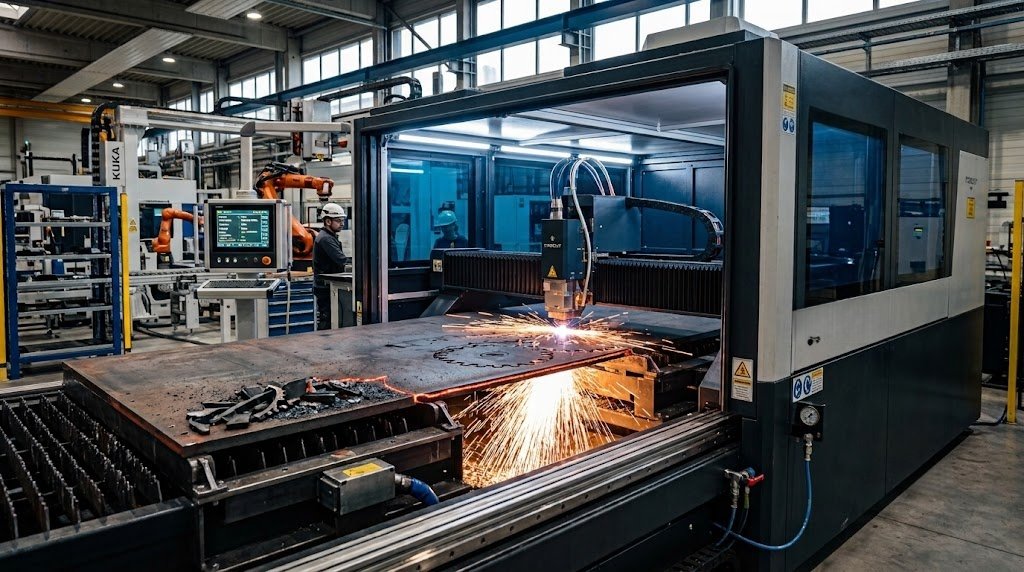
In today's high-precision manufacturing sector—whether you need to deliver automotive parts on schedule for global EV giants or fabricate metal sheets for construction—the efficiency of your factory relies heavily on one core asset: your fiber laser cutting machine.
However, faced with numerous suppliers claiming "high power and fast speed," how do you filter out the noise and find a reliable partner? It goes beyond just comparing price tags. To ensure a long-term return on investment (ROI) and keep your production lines running smoothly 24/7, you must strictly verify the following 5 critical technical factors before placing an order. If you want a comprehensive guide on different machine types, feel free to visit our Laser Equipment Product Center.
1. Does the Manufacturer Possess Self-Developed Core Technologies?
Many suppliers in the current market are merely "assembly plants"—they buy third-party lasers, laser heads, and software from different sources, then assemble them into a chassis. When a technical glitch occurs, troubleshooting often turns into a nightmare of vendors passing the buck to each other.
Therefore, choosing a vendor with a high self-development rate for core components is essential. For instance, truly advanced industrial-grade cutters (like the high-end P Series) typically integrate six core technologies into a unified ecosystem, covering the laser power supply, operating software, and the entire control system. If you are also interested in basic marking applications, you can read our technical discussion on the Fiber Laser Marking Machine.
Why this matters: When hardware and software are developed by the same engineering team, system compatibility reaches its peak. This not only significantly reduces cutting errors but also greatly simplifies post-sale technical support workflows.
2. The Truth About Warranty: Are Core Components Truly Protected?
In heavy industrial manufacturing environments, a traditional 1-year warranty is far from enough to meet a company's risk control needs. Fiber lasers are high-investment equipment; once a core component is damaged, it not only halts the entire production line but also brings exorbitant maintenance costs.
💡 Buyer's Procurement Tip: Be sure to confirm with the vendor whether they provide an industry-leading 5-year warranty on self-developed core major components. If a manufacturer dares to make such a promise, it serves as a powerful trust signal, proving their equipment can withstand harsh factory environments and high-intensity, continuous workloads. To learn more about our R&D capabilities and factory details, please visit our About Us page.
3. Verifying Material Compatibility and Processing Accuracy
Do not just vaguely ask "Can it cut metal?" You need to evaluate the exact cutting thickness and edge quality for specific materials:
- Carbon Steel & Stainless Steel: Check if the cut edges are smooth and burr-free, thereby saving labor costs for secondary polishing.
- Highly Reflective Materials (Aluminum, Brass, Copper): You must ensure the laser system features anti-reflection protection technology to prevent the reflected beam from bouncing back and burning the laser generator.
Before signing a contract, it is highly recommended to ask the supplier to provide real Customer Application Cases and actual cutting video proofs that perfectly match your required material thickness.
4. Integration of the Hardware Ecosystem: Synergy Between Cutting and Welding
If your factory involves sheet metal cutting, there is a high probability that you cannot do without metal joining in subsequent processes. A top-tier industrial partner should not just sell you a standalone cutting machine; they should be able to provide a one-stop metal processing solution. This includes our advanced Laser Welding Machine Series (such as handheld welders or automated robotic welding systems) designed to work seamlessly with the cutting process.
Choosing a supplier that manufactures both cutting and welding systems ensures that your pre-processing (cutting) and post-processing (welding) achieve a perfect fit in terms of material properties and tolerance coordination.
5. A Proven Tracking Record Validated by the Global Supply Chain
The ultimate test of an industrial laser machine's quality lies in whether it can perform stably under the strict delivery deadlines and high-intensity trials of global Tier-1 supply chains. If a Chinese laser equipment manufacturer's machines have successfully helped component suppliers break into the supply chains of global top-tier EV brands like Tesla or passed rigorous industrial audits, their quality control process is clearly more worthy of your trust.
📌 Frequently Asked Questions (FAQ) for Global Buyers
Q1: What is the average lifespan of a fiber laser generator?
A: High-quality fiber laser generators generally have a working lifespan of up to 100,000 hours under proper maintenance and environments. Choosing a supplier with self-developed core components and an extended warranty can significantly reduce your Total Cost of Ownership (TCO).
Q2: Should I choose an air-cooled or water-cooled handheld laser welder?
A: Air-cooled systems are lightweight and flexible, suitable for light-duty or mobile welding tasks. For heavy-duty, long-hour continuous manufacturing, a water-cooled system is strongly recommended to ensure optimal thermal stability. For more technical details, please feel free to Contact Us and reach out to our official engineering team.