

Fiber laser marking and UV laser marking are both used for industrial identification, but they are not equal choices for metal parts. For stainless steel, aluminum, carbon steel, brass, copper, metal nameplates, tools, machinery components, and electronic housings, fiber laser marking is usually the first option to evaluate. UV laser marking is useful in selected cases, especially when the surface is heat-sensitive, coated, extremely small, or part of a mixed-material product.
For metal manufacturers, the decision should not be based only on laser type. The correct choice depends on the material, surface finish, marking content, required contrast, engraving depth, scanning requirement, production volume, and part size. A laser that works well on plastic packaging may not be the most practical choice for stainless steel serial numbers. A laser that produces deep marks on steel may not be suitable for delicate electronic coatings.
This guide compares fiber laser, MOPA fiber laser, and UV laser marking from a metal application perspective, with practical selection rules for QR codes, Data Matrix codes, barcodes, serial numbers, logos, nameplates, and deep engraving.
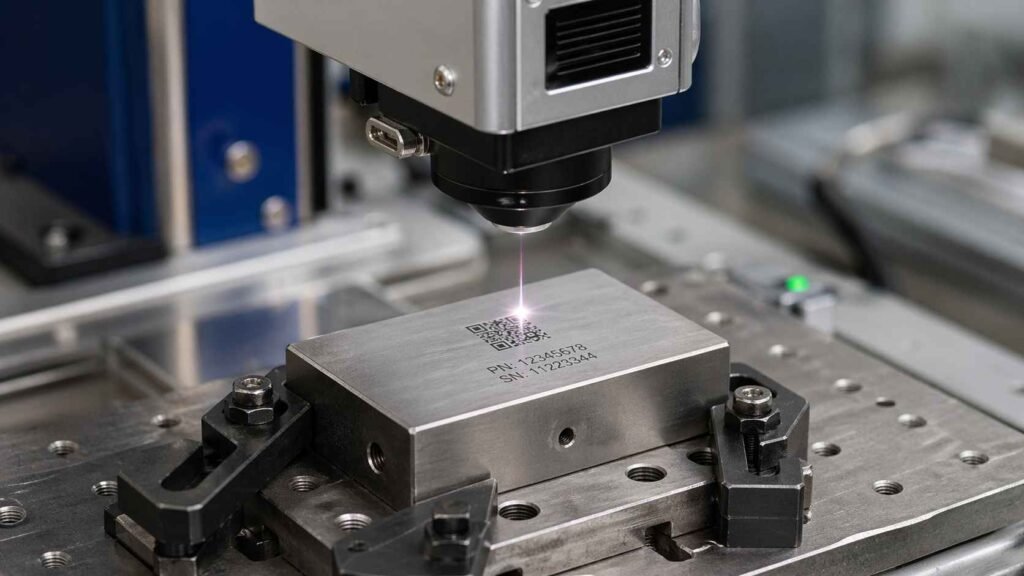
Quick Answer: Fiber Laser Is Usually Better for Metal Marking
For most metal applications, fiber laser marking is the better choice. It is more efficient for stainless steel, aluminum, carbon steel, brass, copper, tools, nameplates, and industrial components. It can create permanent serial numbers, QR codes, Data Matrix codes, barcodes, logos, model numbers, and batch codes without ink, labels, or consumables.
UV laser marking should be considered when the application involves very fine marks, heat-sensitive coatings, thin surface layers, small electronic parts, glass, ceramics, plastics, or mixed materials. For general metal identification, UV laser is often technically possible but not always the most economical or productive option.
| Application Requirement | Recommended Laser Type | Reason |
|---|---|---|
| General metal serial numbers | Fiber laser | Fast, permanent, and cost-effective for most metals |
| QR codes and Data Matrix codes on metal parts | Fiber laser | Good contrast, high speed, and stable readability |
| Deep engraving on steel or tools | Fiber laser | Better for material removal and durable identification |
| Black marking or color control on stainless steel | MOPA fiber laser | More flexible pulse control for surface effect adjustment |
| Fine marking on heat-sensitive coatings | UV laser | Lower thermal impact and finer processing capability |
| Plastic, glass, ceramic, and film marking | UV laser | Better absorption on many non-metal and sensitive materials |
Basic Difference Between Fiber Laser and UV Laser
The main difference is wavelength and how the material absorbs laser energy. Most industrial fiber lasers used for metal marking operate around 1064 nm. UV lasers commonly operate around 355 nm. This shorter UV wavelength allows finer processing and lower thermal impact on many sensitive materials, while fiber laser wavelength is highly practical for many metal surfaces.
| Laser Type | Common Wavelength | Main Strength | Typical Metal Relevance |
|---|---|---|---|
| Standard Fiber Laser | 1064 nm | Fast, durable metal marking and engraving | Best starting point for most metal parts |
| MOPA Fiber Laser | 1064 nm | Adjustable pulse width for finer surface control | Useful for stainless steel black marking, anodized aluminum, and controlled surface effects |
| UV Laser | 355 nm | Fine marking with lower heat effect | Useful for special coatings, delicate surfaces, and mixed-material products |
For buyers focused on stainless steel, aluminum, carbon steel, tools, nameplates, or machinery components, a fiber laser marking machine is usually the most practical starting point. UV laser should be evaluated when the material or surface layer has special sensitivity that fiber laser cannot handle acceptably.
Fiber Laser, MOPA Fiber Laser, and UV Laser: Selection Logic
Many buyers compare only fiber laser and UV laser, but MOPA fiber laser should also be considered for some metal applications. MOPA fiber laser is still a fiber laser, but it provides more flexible pulse control. This can help when the buyer needs better surface effect control on stainless steel, anodized aluminum, or precision metal parts.
| Requirement | Standard Fiber Laser | MOPA Fiber Laser | UV Laser |
|---|---|---|---|
| General metal marking | Excellent | Excellent | Selective |
| Deep engraving on metal | Strong | Strong | Limited |
| High-speed serial number marking | Strong | Strong | Usually less economical |
| Black marking on stainless steel | Possible in some cases | Better control | Not usually preferred |
| Anodized aluminum marking | Good | Better control | Possible for special surfaces |
| Fine marking on sensitive coatings | Depends on coating | Depends on coating | Often better |
| Plastic, glass, ceramic, film | Limited or material-dependent | Limited or material-dependent | Usually better |
| Cost efficiency for metal marking | High | Medium to high | Lower for general metal use |
If the work is mostly metal, fiber laser is normally the first choice. If the metal surface needs better pulse control, MOPA fiber laser may be more suitable. If the work includes many heat-sensitive non-metal materials, UV laser may be worth considering.
Which Laser Is Better for Stainless Steel Marking?
For stainless steel marking, fiber laser is usually better than UV laser. It can create permanent serial numbers, QR codes, barcodes, Data Matrix codes, logos, model numbers, date codes, and batch codes. Stainless steel is widely used in tools, medical hardware, machinery parts, kitchenware, equipment plates, fasteners, fittings, and industrial components, so marking durability is often important.
Standard fiber laser is suitable for most stainless steel identification work. MOPA fiber laser may be a better option when the buyer needs darker marks, better surface control, or more stable black marking effects. UV laser can mark selected stainless steel surfaces, but it is usually not the first choice for regular stainless steel production marking.
| Stainless Steel Requirement | Better Choice | Reason |
|---|---|---|
| Serial numbers and model codes | Fiber laser | Fast, permanent, and easy to automate |
| QR codes and Data Matrix codes | Fiber laser | Good readability when contrast and focus are controlled |
| Deep engraving | Fiber laser | Better for durable material removal |
| Black marking on stainless steel | MOPA fiber laser | More flexible pulse settings for surface effect control |
| Ultra-fine marking on sensitive surface areas | UV laser may be tested | Useful only when heat effect must be minimized |
For stainless steel applications, buyers can review how to choose a fiber laser marking machine for stainless steel parts before deciding the machine type, marking effect, and fixture setup.
Which Laser Is Better for Aluminum Marking?
Fiber laser is commonly used for aluminum marking, including raw aluminum, anodized aluminum, aluminum nameplates, electronic housings, control panels, machined parts, and equipment tags. The result depends heavily on the surface finish. Raw aluminum may need parameter adjustment for contrast, while anodized aluminum often produces cleaner and more visible marks.
MOPA fiber laser can be useful when the buyer needs better control on anodized aluminum or wants to reduce unwanted surface damage. UV laser may be considered when the coating is very thin, delicate, or heat-sensitive. However, for general aluminum serial numbers, barcodes, QR codes, and logos, fiber laser is usually more practical.
| Aluminum Surface | Recommended Direction | Buyer Checkpoint |
|---|---|---|
| Raw aluminum | Fiber laser | Check contrast and scanner readability |
| Anodized aluminum | Fiber laser or MOPA fiber laser | Confirm whether the mark removes or changes the anodized layer |
| Polished aluminum | Fiber laser with sample testing | Reflection may affect QR code scanning |
| Thin coated aluminum | MOPA fiber laser or UV laser testing | Check coating sensitivity and edge quality |
| Aluminum electronic housings | Fiber laser or MOPA fiber laser | Balance appearance, contrast, and production speed |
What About Copper, Brass, Gold, and Silver?
Copper, brass, gold, and silver can be more challenging than stainless steel because reflectivity and heat behavior affect marking results. Fiber laser can mark many copper and brass parts, but sample testing is more important. The correct choice depends on surface finish, required contrast, marking depth, and whether the part is polished, coated, plated, or oxidized.
| Metal | General Direction | Important Checkpoint |
|---|---|---|
| Copper | Fiber laser or special parameter testing | Reflectivity and contrast should be tested on the real part |
| Brass | Fiber laser | Surface finish and oxidation influence final contrast |
| Gold | Application-specific testing | Often used for fine or decorative marking, requiring careful parameter control |
| Silver | Application-specific testing | High reflectivity may require careful setup and sample validation |
| Plated metal | Fiber, MOPA, or UV depending on plating layer | Confirm whether the laser affects only the coating or reaches the base metal |
For reflective or plated metals, the safest approach is to send real samples before selecting the machine. General material names are not enough to predict the final result.
Fiber Laser Is Better for Deep Engraving on Metal
If the application requires deep engraving, fiber laser is normally the better choice. Deep engraving removes material and creates a more durable mark. This is useful when the metal part is exposed to friction, abrasion, cleaning, outdoor use, heat, or harsh handling.
Common deep engraving applications include:
- tool identification
- metal mold marking
- machinery part serial numbers
- automotive part traceability
- industrial nameplates and rating plates
- metal components used in abrasive environments
UV laser is generally not selected for deep metal engraving. Its advantage is fine surface processing with lower heat impact, not heavy material removal. If deep, permanent, wear-resistant marking is required, fiber laser is usually the correct direction.
UV Laser Is Better for Heat-Sensitive and Fine Surface Marking
UV laser has real value when the marking task involves delicate materials or fine surface layers. It is often selected when the buyer needs reduced heat effect, smaller spot size, finer details, or marking on materials that do not respond well to fiber laser.
UV laser may be a better option for:
- thin coatings that may burn or deform easily
- small electronic components
- plastic and metal combined products
- glass, ceramic, film, or packaging materials
- precision parts with strict surface appearance requirements
- applications where thermal deformation must be minimized
For pure metal marking, UV laser should be selected only when it solves a real problem. If the requirement is ordinary metal serial numbers, QR codes, logos, or nameplates, fiber laser normally provides a better balance of speed, cost, durability, and production convenience.
When UV Laser Is Not Worth the Extra Cost for Metal Marking
UV laser systems are usually selected for special applications, not general metal marking. For many metal factories, UV laser may increase the purchase cost without improving the final production result. If a fiber laser can meet the contrast, depth, speed, and durability requirements, UV laser is usually unnecessary.
UV laser may not be worth the extra cost when the application involves:
- standard stainless steel serial numbers
- aluminum nameplate marking
- carbon steel part identification
- tool logos and size markings
- deep engraving on metal
- QR codes or Data Matrix codes on ordinary metal parts
- batch production where speed and operating cost are important
In these cases, a standard fiber laser or MOPA fiber laser is usually more practical. UV laser should be considered only when the surface is too sensitive for fiber laser or when the buyer also needs to mark plastics, glass, ceramics, films, or delicate electronic materials.
QR Codes, Data Matrix Codes, and Serial Numbers on Metal
For traceability marking on metal, fiber laser is usually preferred. It can mark serial numbers, QR codes, Data Matrix codes, barcodes, logos, model numbers, batch numbers, and date codes. The main challenge is not only creating the mark, but keeping it readable in real production and after use.
| Marking Content | Recommended Laser for Metal | Key Requirement |
|---|---|---|
| Serial number | Fiber laser | Automatic numbering, clear characters, duplicate prevention |
| QR code | Fiber laser | Good contrast, correct size, stable scanning |
| Data Matrix code | Fiber laser | Small module clarity and scanner compatibility |
| Barcode | Fiber laser | Line clarity and sufficient marking length |
| Micro code on sensitive coating | UV laser may be tested | Fine edge control and low heat effect |
For QR codes and Data Matrix codes, deeper marking is not always better. Excessive engraving depth can reduce edge clarity and make small codes harder to scan. The correct result depends on contrast, module size, focus height, surface finish, and scanner type.
How to Improve Code Readability on Metal Parts
Metal surfaces can reflect light, collect oil, or create uneven contrast. This can affect QR code and Data Matrix scanning. For industrial traceability, the code should be tested under real working conditions instead of only checking it visually.
To improve readability, buyers should confirm:
- the correct code size for the amount of encoded data
- sufficient contrast between marked and unmarked areas
- stable focus height during marking
- clean code edges without excessive melting or blur
- fixture support for repeatable part positioning
- scanner compatibility with QR code or Data Matrix format
- scanning performance under factory, warehouse, or field lighting
If every part needs a unique code, the marking software should support automatic serial number generation, date code generation, QR code generation, barcode generation, and data import. This helps reduce repeated codes, missed numbers, and manual input errors.
Machine Structure Also Matters: Desktop, Portable, Rotary, or Production Line
The correct laser type is only part of the decision. Machine structure also affects production efficiency. A flat nameplate and a large assembled machine body do not need the same setup. A round pipe or shaft may require rotary support. A heavy metal component may require a portable marking solution.
| Part Type | Recommended Setup | Reason |
|---|---|---|
| Small metal parts | Desktop fiber laser marking machine | Stable focus and easy fixture setup |
| Nameplates and tags | Fiber laser with positioning fixture | Efficient batch marking and repeatability |
| Pipes, shafts, rings, and tubes | Fiber laser with rotary device | Keeps curved surfaces aligned during marking |
| Large metal parts or assembled equipment | Portable fiber laser marking machine | Reduces handling when the workpiece is difficult to move |
| High-volume production | Customized fixture or production-line integration | Improves speed, consistency, and operator workflow |
For large workpieces, assembled equipment, or products that cannot be easily placed under a fixed marking head, a portable laser marking machine may be more practical than a desktop system. For repeated production marking, the broader laser marking machine configuration should be selected based on part size, daily quantity, and fixture requirements.
Production Speed and Operating Cost
For metal applications, fiber laser usually has a stronger balance of marking speed, operating cost, maintenance convenience, and production stability. It does not require ink, labels, solvent, or frequent consumable replacement. This makes it suitable for factories that mark metal parts every day.
UV laser is often more expensive and is usually selected for special material behavior rather than standard metal marking. If the buyer only needs serial numbers, QR codes, barcodes, model numbers, or logos on metal parts, UV laser may not provide enough additional value to justify the higher cost.
| Comparison Point | Fiber Laser | MOPA Fiber Laser | UV Laser |
|---|---|---|---|
| General metal marking | Excellent | Excellent | Selective |
| Deep engraving | Strong | Strong | Weak |
| Fine surface control on metal | Good | Better | Good for special surfaces |
| Heat-sensitive non-metal materials | Limited | Limited | Strong |
| Production speed on metal | High | High | Usually lower |
| Cost efficiency for metal marking | High | Medium to high | Lower |
How to Choose Before Buying
Before choosing between fiber laser and UV laser, buyers should define the marking task clearly. The same metal name may produce different results depending on surface treatment, coating, polishing, oxidation, or part geometry.
| Information to Provide | Why It Matters |
|---|---|
| Metal material | Different metals absorb laser energy differently |
| Surface finish | Brushed, polished, anodized, coated, painted, or plated surfaces affect contrast |
| Marking content | Text, logo, QR code, barcode, serial number, and Data Matrix code have different requirements |
| Required depth | Surface marking and deep engraving require different power and parameters |
| Code size | Small QR codes and Data Matrix codes require better edge control and readability testing |
| Production quantity | Daily output affects machine structure, fixture design, and workflow |
| Part size and shape | Flat, curved, round, or large parts may need different setups |
| Scanning requirement | Traceability codes should be tested with the actual scanner |
Sample testing is strongly recommended when the surface is polished, coated, plated, reflective, very small, or connected to strict traceability requirements. Testing on the real part is more reliable than testing on a general sample plate.
Conclusion: Choose Fiber Laser First for Most Metal Parts
For most metal applications, fiber laser marking is the better and more practical choice. It is suitable for stainless steel, aluminum, carbon steel, brass, copper, tools, nameplates, machinery parts, electronic housings, serial numbers, QR codes, Data Matrix codes, barcodes, logos, and deep engraving.
MOPA fiber laser should be considered when the buyer needs better pulse control, improved surface effect control, black marking on stainless steel, or finer results on anodized aluminum. UV laser should be considered when the material is heat-sensitive, coated, very small, or part of a mixed-material application that includes plastics, glass, ceramics, films, or delicate electronic materials.
For standard metal marking, UV laser is often not necessary unless it solves a specific surface or heat-related problem. Buyers should first evaluate the real metal part, marking content, depth requirement, production volume, and scanning method before deciding the laser type.
Send material details, part photos, marking content, code size, required depth, and daily quantity to MADE Laser to confirm whether a standard fiber laser marking machine, MOPA fiber laser marking machine, portable marking machine, rotary device, or special laser marking setup is more suitable.
FAQ
Is fiber laser or UV laser better for metal marking?
Fiber laser is usually better for metal marking. It is more suitable for stainless steel, aluminum, carbon steel, brass, copper, tools, nameplates, machinery parts, serial numbers, QR codes, Data Matrix codes, barcodes, and deep engraving. UV laser is mainly used for special surfaces, heat-sensitive materials, and fine marking requirements.
Can UV laser mark metal parts?
Yes, UV laser can mark selected metal parts, but it is not usually the first choice for general industrial metal marking. It may be useful for delicate coatings, fine surface marks, or mixed-material products. For regular metal serial numbers, QR codes, and logos, fiber laser is usually more practical.
What is the difference between fiber laser and UV laser marking?
Fiber laser marking commonly uses a 1064 nm wavelength and is well suited for many metal applications. UV laser marking commonly uses a 355 nm wavelength and is better for fine marking, lower thermal impact, and sensitive materials such as plastics, glass, ceramics, films, and special coatings.
Is MOPA fiber laser better than standard fiber laser for metal?
MOPA fiber laser can be better when the buyer needs more control over pulse width and surface effect. It is useful for black marking on stainless steel, anodized aluminum marking, and applications that need more precise parameter adjustment. For ordinary metal serial numbers and logos, standard fiber laser is often enough.
Which laser is better for stainless steel marking?
Fiber laser is usually better for stainless steel marking. It can create permanent serial numbers, QR codes, Data Matrix codes, barcodes, logos, model numbers, and batch codes. MOPA fiber laser may be preferred when darker marks or better surface control are required.
Which laser is better for aluminum marking?
Fiber laser is commonly used for aluminum marking, including raw aluminum, anodized aluminum, aluminum nameplates, and electronic housings. MOPA fiber laser may provide better control on anodized aluminum. UV laser may be tested when the coating is very thin or heat-sensitive.
Which laser is better for copper and brass marking?
Fiber laser can mark many copper and brass parts, but sample testing is important because reflectivity and surface finish affect the result. Brass is usually easier to mark than highly reflective polished copper. For plated or decorative metals, the real surface layer should be tested before machine selection.
Which laser is better for QR codes on metal parts?
Fiber laser is usually better for QR codes and Data Matrix codes on metal parts. It provides good contrast, stable marking speed, and durable traceability. The code size, surface finish, scanner type, and lighting conditions should be tested before batch production.
Is UV laser better for fine marking?
UV laser can be better for fine marking on heat-sensitive materials, thin coatings, plastics, glass, ceramics, films, and delicate electronic components. For standard metal marking, fiber laser or MOPA fiber laser is usually more suitable.
Which laser is better for deep engraving on metal?
Fiber laser is better for deep engraving on metal. It is suitable for durable marks on tools, molds, machinery parts, nameplates, automotive parts, and components exposed to wear or harsh handling. UV laser is not normally selected for deep metal engraving.
Is UV laser worth buying for metal marking?
UV laser is worth considering only when the metal surface is heat-sensitive, coated, very small, or part of a mixed-material product. For regular metal serial numbers, QR codes, logos, nameplates, and deep engraving, fiber laser is usually more cost-effective.
What information is needed before choosing fiber laser or UV laser?
Buyers should provide the metal material, surface finish, part photos or drawings, marking content, code size, required depth, production quantity, and scanning method. These details help confirm whether standard fiber laser, MOPA fiber laser, UV laser, portable marking, or rotary marking is the right choice.