

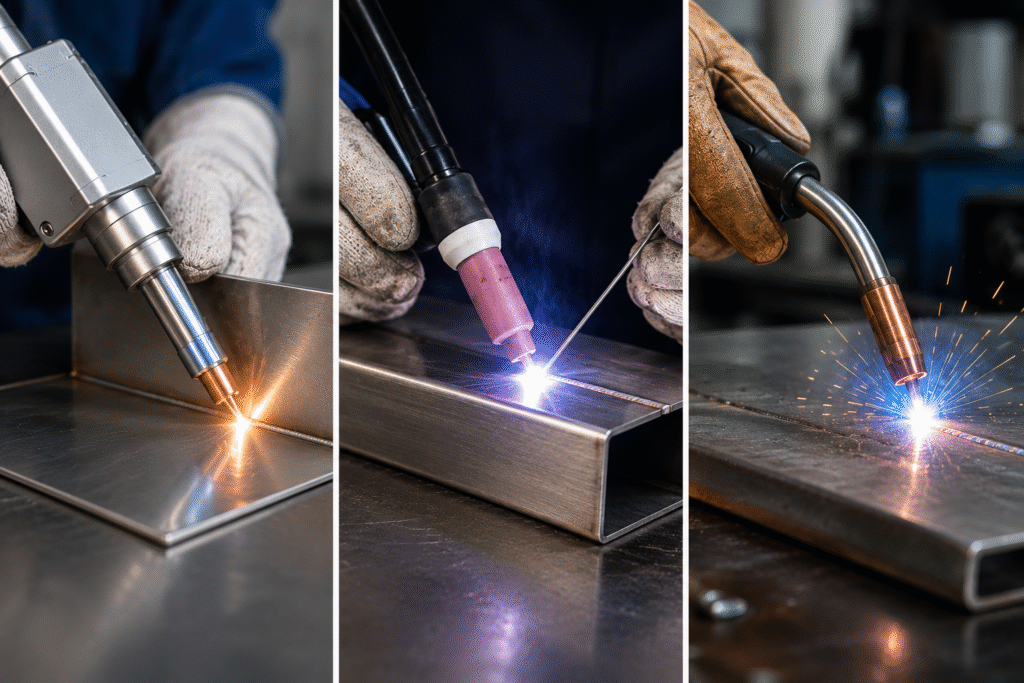
For many metal fabrication workshops, welding quality, production speed and labor cost directly affect daily output. Traditional TIG and MIG welding are still widely used, but more manufacturers are now considering handheld laser welding machines as an alternative for stainless steel, carbon steel, aluminum and sheet metal fabrication.
So, is a handheld laser welding machine better than TIG or MIG welding? The answer depends on your material, thickness, production volume, welding appearance requirements and operator experience.
This guide compares handheld laser welding, TIG welding and MIG welding from a practical purchasing perspective, helping metal fabrication companies choose the right welding solution for their workshop.
What Is a Handheld Laser Welding Machine?
A handheld laser welding machine is an industrial welding system that uses a focused laser beam to join metal parts. Unlike traditional arc welding, laser welding creates a narrow, concentrated heat source, allowing faster welding speed, smaller heat-affected zones and cleaner weld seams.
For many workshops, handheld laser welding is especially suitable for:
- Stainless steel sheet welding
- Carbon steel fabrication
- Aluminum alloy welding
- Metal cabinets and enclosures
- Kitchenware and appliances
- Advertising signs and metal letters
- HVAC components
- Door and window frames
- Sheet metal parts
- Precision metal products
Compared with traditional welding methods, a handheld laser welder can reduce the need for grinding, polishing and rework after welding. This is one of the main reasons why more factories are upgrading their welding process with a modern laser welding machine.
TIG, MIG and Laser Welding: What Is the Difference?
TIG, MIG and laser welding can all be used for metal joining, but they work in different ways.
TIG welding uses a tungsten electrode and requires high operator skill. It can produce clean welds, but the process is relatively slow.
MIG welding uses a continuously fed wire electrode. It is faster than TIG in many applications and suitable for general fabrication, but it may create more spatter and require more post-weld cleaning.
Laser welding uses a focused laser beam to melt and join the metal. It is known for high speed, narrow weld seams, low deformation and cleaner appearance.
| Comparison Item | Handheld Laser Welding | TIG Welding | MIG Welding |
|---|---|---|---|
| Welding speed | Fast | Slow | Medium to fast |
| Operator skill requirement | Lower after training | High | Medium |
| Heat input | Low | Medium to high | Medium to high |
| Deformation | Low | Higher on thin metal | Medium |
| Weld seam appearance | Clean and narrow | Clean but slow | More spatter |
| Post-processing | Less grinding and polishing | Less spatter but slow | More cleaning needed |
| Thin sheet performance | Very good | Good but skill-dependent | Easier to burn through |
| Best for | Sheet metal, stainless steel products, cabinets, precision parts | Precision manual welding | General steel fabrication |
Advantages of Handheld Laser Welding
1. Faster Welding Speed
One of the biggest advantages of handheld laser welding is speed. For many sheet metal and stainless steel applications, laser welding can complete the job much faster than TIG welding.
This is important for factories that need to improve daily output without adding more operators. In industries such as metal cabinets, stainless steel products, kitchen equipment, advertising signs and appliance parts, faster welding can directly improve delivery efficiency.
2. Cleaner Weld Seam
A handheld laser welder can create a narrow and smooth weld seam. In many applications, the finished weld requires less grinding or polishing.
This is especially useful for visible metal products, such as:
- Stainless steel kitchen equipment
- Decorative metal panels
- Metal display racks
- Furniture hardware
- Electrical cabinets
- Advertising letters
- Door and window frames
For products where appearance matters, cleaner weld seams help reduce finishing time and improve the final product quality.
3. Lower Heat Deformation
Traditional welding methods create larger heat-affected areas. When welding thin stainless steel, aluminum or sheet metal parts, too much heat can cause deformation, warping or burn-through.
Laser welding concentrates heat in a small area. This helps reduce thermal distortion and makes it easier to weld thin materials with better shape control.
For sheet metal manufacturers, this advantage is very important because deformation can lead to extra correction work, product rejection or assembly problems.
4. Easier for New Operators to Learn
TIG welding usually requires experienced welders. A skilled TIG welder needs good hand control, stable movement and strong understanding of welding parameters.
Handheld laser welding is easier to learn after proper training. Operators can often produce stable welds with less experience compared with TIG welding.
This does not mean laser welding requires no training. Operators still need to understand material type, thickness, laser power, welding speed, safety protection and machine operation. However, for factories facing skilled labor shortages, handheld laser welding can reduce dependence on highly experienced welders.
5. Less Post-Weld Processing
Grinding, polishing and cleaning can take a lot of time after welding. MIG welding may produce spatter, while TIG welding is clean but slow.
In many applications, laser welding can reduce post-processing work. This helps lower labor costs and improves production efficiency.
For manufacturers that care about both welding speed and appearance, a laser welding machine can be a practical upgrade.
When Should You Choose a Handheld Laser Welding Machine?
A handheld laser welding machine is a good choice if your workshop needs faster welding, cleaner seams and lower deformation.
It is especially suitable when you work with:
- Stainless steel
- Carbon steel
- Galvanized sheet
- Aluminum alloy
- Thin to medium-thickness sheet metal
- Precision metal parts
- Products with visible weld seams
You should consider handheld laser welding if you have these production needs:
- Your TIG welding speed is too slow.
- Your MIG welding creates too much spatter.
- Your products require a clean appearance.
- Thin sheet metal is easily deformed during welding.
- You want to reduce grinding and polishing.
- Skilled welders are difficult to hire.
- Your factory needs higher output with stable quality.
For example, stainless steel product manufacturers, sheet metal fabrication shops, cabinet factories, HVAC component producers and metal sign manufacturers can all benefit from handheld laser welding.
When TIG or MIG Welding May Still Be Better
Although handheld laser welding has many advantages, TIG and MIG welding are still useful in many workshops.
TIG welding may still be suitable for highly specialized welding tasks that require detailed manual control by experienced welders. It is also commonly used for certain precision applications where the operator needs full control of the welding process.
MIG welding may still be preferred for some heavy-duty general fabrication jobs, especially when the budget is limited or when weld appearance is not the main priority.
In other words, laser welding does not completely replace TIG or MIG in every situation. The best choice depends on your material, thickness, production target and product quality requirements.
A professional supplier should not simply tell you that one process is always better. Instead, they should help you choose the right solution based on your real working conditions.
Handheld Laser Welding vs TIG Welding
TIG welding is known for clean welds, but it is usually slow and requires skilled operators. For factories that produce stainless steel products or sheet metal parts in batches, TIG welding may limit production speed.
Handheld laser welding can be a better option when you need:
- Faster production
- Lower labor dependence
- Cleaner weld seams
- Less deformation
- Less polishing after welding
- Stable quality for repeated workpieces
For thin stainless steel, sheet metal cabinets, kitchen equipment and decorative metal products, laser welding often provides better overall efficiency.
However, TIG welding may still be useful for small-volume custom jobs or applications where highly skilled manual welding control is required.
Handheld Laser Welding vs MIG Welding
MIG welding is widely used in metal fabrication because it is faster than TIG and suitable for many general welding tasks. However, MIG welding can create spatter and may require more cleaning after welding.
Handheld laser welding is often preferred when the final product needs a cleaner appearance and less finishing work.
Compared with MIG welding, handheld laser welding can help:
- Reduce spatter
- Improve weld appearance
- Lower heat deformation
- Reduce grinding and polishing
- Improve efficiency for sheet metal products
For workshops producing visible metal components, stainless steel products or precision sheet metal parts, handheld laser welding may offer better final results.
MIG welding may still be suitable for heavy structural fabrication or applications where appearance is less important.
How to Choose the Right Handheld Laser Welding Machine
Before buying a handheld laser welding machine, you should evaluate your actual production needs. Choosing the wrong power, cooling system or configuration may affect welding quality and long-term performance.
1. Material Type
Different metals have different welding requirements. You should confirm whether the machine will be used for stainless steel, carbon steel, aluminum, galvanized sheet or mixed materials.
If your factory mainly welds stainless steel sheets, the machine configuration may be different from a factory that welds aluminum or thicker carbon steel parts.
2. Material Thickness
Material thickness is one of the most important factors when choosing laser power. Thin sheet metal usually requires different welding parameters from thicker plates.
Before purchasing, prepare a list of your common material thicknesses. This helps the supplier recommend a suitable machine model and laser power.
3. Cooling Method
Handheld laser welding machines usually use water cooling or air cooling.
Water-cooled laser welding machines are commonly used for continuous industrial production and higher-power applications.
Air cooled handheld laser welding machines are more compact and easier to move. They may be suitable for workshops that need a lighter, more flexible welding solution.
If mobility, compact structure and simple operation are important, an air-cooled model may be a practical choice.
4. Welding Speed and Production Volume
If your factory has high daily production volume, you should choose a machine that can support stable long-time operation.
For small workshops, flexibility and ease of operation may be more important. For large factories, production stability, cooling performance and after-sales support should be carefully evaluated.
5. Wire Feeding Requirement
Some welding applications require wire feeding to fill gaps or improve weld strength. When choosing a handheld laser welding machine, check whether the system supports automatic wire feeding.
This is especially useful when the workpiece fit-up is not perfect or when stronger filling is required.
6. Operator Safety
Laser welding requires proper safety protection. Operators should use laser safety glasses, protective clothing and follow standard operating procedures.
The working area should also be properly controlled to prevent accidental laser exposure.
When buying a machine, safety training and operation guidance are just as important as machine performance.
7. Supplier Experience and After-Sales Support
A reliable laser equipment supplier should provide more than just a machine. They should help you with model selection, parameter advice, machine training, spare parts and technical support.
Before placing an order, ask the supplier:
- Can you test my material?
- Can you recommend parameters based on my thickness?
- Do you provide operation training?
- What spare parts are included?
- How do you support overseas customers?
- Can you provide videos or samples for similar applications?
These questions can help you avoid buying a machine that does not match your real production needs.
Common Applications of Handheld Laser Welding
Stainless Steel Products
Stainless steel products often require clean and attractive welds. Laser welding can reduce deformation and polishing work, making it suitable for kitchenware, shelves, cabinets, sinks, doors and decorative products.
Sheet Metal Fabrication
Sheet metal factories often work with thin plates and precision parts. Laser welding helps control heat input and reduce warping, which is important for cabinets, enclosures and machine covers.
Advertising Signs
Metal signs and advertising letters need clean seams and good appearance. Handheld laser welding can improve both welding speed and final product quality.
HVAC and Appliance Parts
HVAC components and appliance parts often require stable welding quality and batch production efficiency. Laser welding can help reduce labor and finishing time.
Automotive and Hardware Parts
For some automotive components, hardware products and metal frames, laser welding can improve consistency and reduce post-weld processing.
Is Handheld Laser Welding Worth the Investment?
For many workshops, the value of handheld laser welding is not only the machine itself. The real value comes from higher efficiency, cleaner welds, reduced rework and lower dependence on highly skilled welders.
If your factory only has occasional welding jobs, TIG or MIG may still be enough. But if welding is part of your daily production, and you want to improve speed and appearance, a handheld laser welding machine can be a strong investment.
The best way to decide is to compare your current welding process with the expected improvements:
- How many hours do you spend welding every day?
- How much time is spent grinding and polishing?
- How often does deformation cause rework?
- Are skilled welders difficult to find?
- Do customers require better weld appearance?
- Are you planning to increase production capacity?
If these problems are affecting your workshop, laser welding may help improve your production process.
Handheld, Air-Cooled or Robotic Laser Welding: Which One Should You Choose?
Different workshops may need different laser welding solutions. A standard handheld laser welding machine is suitable for flexible workshop welding and general metal fabrication. An air cooled handheld laser welding machine is more suitable for users who need a compact and portable solution. For automated production lines or repeated batch welding, a robotic laser welding machine may provide better consistency and labor-saving performance.
If you are not sure which type is suitable for your application, compare your material, thickness, daily workload, workplace conditions and automation requirements before making a decision.
FAQ About Handheld Laser Welding Machines
Can a handheld laser welding machine weld stainless steel?
Yes. Handheld laser welding machines are widely used for stainless steel welding. They can produce clean, narrow weld seams and reduce polishing work, making them suitable for stainless steel products, cabinets, kitchen equipment and decorative metal parts.
Can laser welding replace TIG welding?
Laser welding can replace TIG welding in many sheet metal and stainless steel applications, especially when speed, appearance and efficiency are important. However, TIG welding may still be useful for certain specialized manual welding tasks.
Is laser welding better than MIG welding?
Laser welding is often better for applications that require cleaner welds, lower deformation and less post-processing. MIG welding may still be suitable for some heavy-duty general fabrication jobs where appearance is not the main concern.
Is handheld laser welding easy to learn?
Compared with TIG welding, handheld laser welding is generally easier for new operators to learn after proper training. However, operators still need to understand safety rules, machine settings and correct welding methods.
Can handheld laser welding weld aluminum?
Yes, handheld laser welding can be used for aluminum alloy welding, but the machine configuration and welding parameters should be selected carefully. It is best to test your actual aluminum material before purchasing.
What thickness can a handheld laser welding machine weld?
The weldable thickness depends on the laser power, material type, joint design and welding requirements. Before choosing a machine, provide your material type and thickness to the supplier for a suitable recommendation.
Do I need wire feeding for laser welding?
Not always. Some applications can be welded without wire feeding if the parts fit well. For larger gaps or applications requiring more filling, wire feeding can be useful.
Conclusion: Which Welding Method Is Right for Your Workshop?
TIG, MIG and handheld laser welding all have their own advantages. TIG welding offers strong manual control but is slow and requires skilled welders. MIG welding is suitable for many general fabrication jobs but may create more spatter and require more cleaning. Handheld laser welding offers faster speed, cleaner seams, lower deformation and easier operation for many sheet metal and stainless steel applications.
For metal fabrication workshops that want to improve efficiency and weld appearance, a handheld laser welding machine is worth considering.
If you are not sure which machine is suitable for your material and thickness, MADE Laser can help you evaluate your requirements and recommend a suitable handheld, air-cooled or robotic laser welding solution.
Need Help Choosing a Laser Welding Machine?
Send us your material type, thickness, workpiece photos and production requirements. Our team will help you choose the right laser welding machine for your workshop.
```