

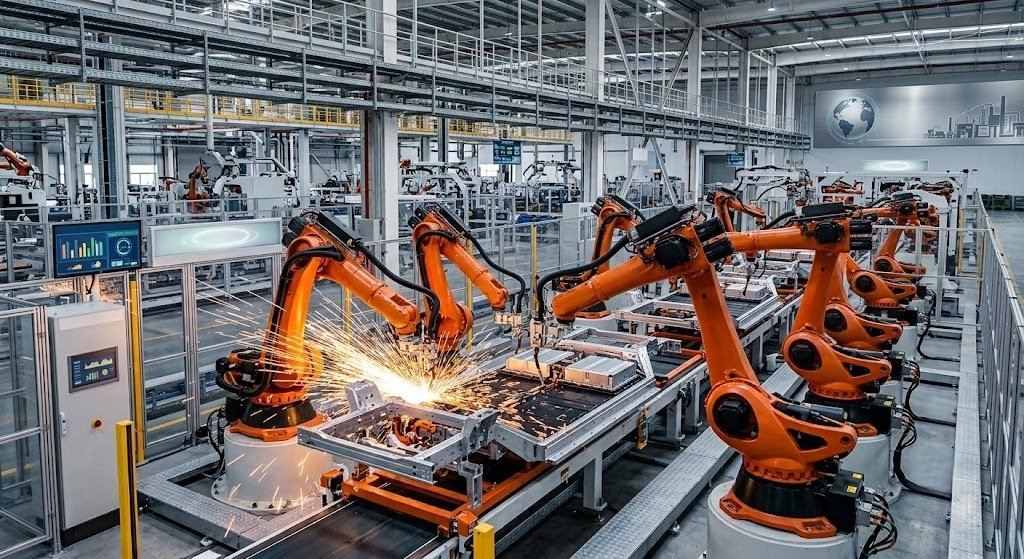
The global transition toward electric vehicles (EVs) has placed unprecedented demands on automotive tier-1 suppliers and manufacturers. To achieve a longer driving range, EV components—especially battery packs, trays, and structural enclosures—must be engineered for maximum lightweighting without compromising structural crash safety. On the modern automotive shop floor, traditional mechanical stamping and TIG welding are no longer sufficient. Today, precision laser technology in EV manufacturing has become the core driver of production efficiency.
From complex lightweight alloy slicing to hermetic sealing of copper and aluminum cells, advanced laser systems ensure that production lines meet both stringent geometric tolerances and rapid cycle times. As a specialized global China Laser Machine Manufacturer, we have analyzed how advanced laser solutions optimize the fabrication of critical EV components. To explore our full machinery lineup, feel free to visit our Laser Equipment Product Center.
1. High-Speed Trimming of Aluminum Battery Enclosures
EV battery trays and protective covers are primarily made from high-strength 6000-series aluminum alloys or extruded aluminum profiles. Trimming these large-format structures with mechanical CNC tools leads to rapid blade wear and localized material deformation.
Deploying an industrial-grade fiber laser cutting machine solves these engineering challenges by offering several distinct advantages:
- Non-Contact Processing: Zero mechanical stress prevents thin-walled aluminum sheets from bending or warping during high-speed cutting.
- Intelligent Software Nesting: Allows automotive engineers to tightly nest irregular parts, reducing expensive alloy waste by up to 15%.
To see how heavy-duty cutting hardware integrates with intelligent operating systems to deliver high processing accuracy, you can check our specialized Laser Cutting Machine line.
2. Hermetic Sealing: Welding Copper and Aluminum Cells
Inside the EV battery pack, connecting individual cells requires joining highly reflective and dissimilar metals, such as copper busbars to aluminum terminals. This process requires absolute precision; any excessive heat input can damage the internal chemical structures of the battery cell, while a weak joint can cause catastrophic electrical resistance failures.
This is where an automated Laser Welding Machine Series becomes essential. By utilizing precise laser power modulation, these systems achieve deep-penetration welding with a minimal heat-affected zone (HAZ), securing a perfectly hermetic, low-resistance connection capable of withstanding constant road vibrations.
3. Traceability: Safeguarding the Battery Lifecycle
Every single EV battery pack must carry a permanent, readable identification mark to track its entire lifecycle—from manufacturing and vehicle assembly to second-life recycling. The marking system must engrave unique DataMatrix codes capable of surviving extreme thermal exposure, chemical washes, and physical abrasion. Utilizing specialized fiber or MOPA laser sources ensures these critical tracking codes remain crisp and scannable for decades without altering the protective coatings of the battery shell.
📌 Technical FAQ for EV Component Procurement
Q1: Can fiber lasers cut highly reflective metals like copper and aluminum safely?
A: Yes. Modern industrial fiber lasers are equipped with specialized back-reflection isolation systems. These safety features protect the resonator by safely absorbing any bounced laser beams, allowing for continuous, high-volume processing of reflective automotive alloys.
Q2: Why is laser welding preferred over traditional TIG/MIG welding for EV battery trays?
A: Laser welding delivers up to 5 times faster processing speeds, dramatically less thermal distortion, and completely eliminates the need for filler wires or post-weld grinding, making it perfect for high-throughput, automated automotive assembly lines.
Are you looking to optimize your automotive production line, enhance manufacturing precision, or break into the global Tier-1 EV supply chain? Our application engineering team has extensive experience helping factories scale up their hardware capabilities. Please visit our Contact Us page today to discuss your project blueprint, request material cutting tests, or receive a direct factory quotation!