

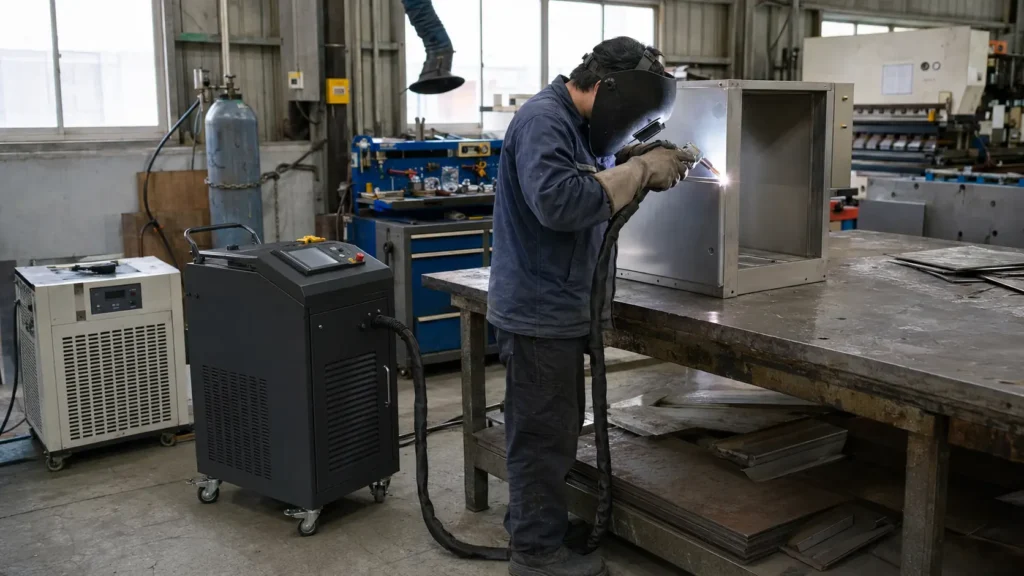
Handheld laser welding has become a practical option for manufacturers that want to increase welding speed, reduce post-weld finishing and produce cleaner seams on stainless steel, carbon steel, galvanized sheet and aluminum components. However, choosing a handheld laser welder involves more than comparing laser power and price.
One of the first decisions buyers face is whether to select an air-cooled or water-cooled system. Both configurations use laser energy to join metal, but they differ in cooling structure, machine size, operating conditions, maintenance requirements and suitability for continuous production.
This guide compares air-cooled and water-cooled handheld laser welding machines from a practical purchasing perspective. It will help metal fabricators, workshop owners and equipment distributors determine which configuration better matches their production environment.
Why Does a Handheld Laser Welding Machine Need Cooling?
A fiber laser source and its related optical and electrical components generate heat during operation. If this heat is not controlled effectively, the temperature of the system can rise and affect output stability, component life and welding consistency.
A cooling system removes this heat and helps the laser operate within its intended temperature range. Handheld laser welding machines generally use one of two cooling methods:
- Air cooling: Fans and internal airflow transfer heat away from the laser system.
- Water cooling: A separate or integrated industrial chiller circulates coolant through the system to remove heat.
The cooling method does not determine welding quality by itself. Laser power, welding speed, wire feeding, focus position, shielding gas, material condition and operator technique also influence the final weld.
What Is an Air-Cooled Handheld Laser Welding Machine?
An air-cooled handheld laser welder uses a fan-based thermal management system instead of a conventional industrial water chiller. Removing the chiller allows the machine to have a more compact structure and reduces the number of cooling-related components that require routine attention.
This configuration is particularly attractive to workshops that need to move the equipment between workstations or weld products at different locations within the factory.
MADE Laser offers an air-cooled handheld laser welding machine for buyers who prioritize a compact footprint and flexible workshop deployment.
Main advantages of air-cooled systems
- More compact machine structure
- Easier movement around the workshop
- No separate water tank or traditional chiller circuit
- Reduced coolant-related maintenance
- Faster preparation for temporary or changing workstations
- Suitable for factories with limited floor space
Points buyers should consider
Air-cooled equipment still needs adequate ventilation. Dust, high ambient temperatures and blocked airflow can reduce cooling efficiency. Buyers should confirm the recommended operating temperature and duty cycle with the supplier instead of assuming that every air-cooled model is suitable for uninterrupted high-load production.
What Is a Water-Cooled Handheld Laser Welding Machine?
A water-cooled handheld laser welding machine uses an industrial chiller to circulate temperature-controlled coolant. Water has a strong capacity to absorb and transfer heat, which makes this configuration widely used in industrial laser equipment.
Water-cooled systems are often selected for fixed production areas where the machine performs regular or extended welding tasks. The chiller adds size and maintenance requirements, but it can provide stable thermal control under demanding operating conditions when correctly configured.
Buyers considering a conventional system can review the handheld laser welding machine from MADE Laser and discuss the appropriate power, cooling and accessory configuration for their application.
Main advantages of water-cooled systems
- Effective heat removal for industrial operation
- Well suited to fixed production workstations
- Commonly available across different power configurations
- Suitable for regular production schedules
- Stable temperature control when the chiller is correctly maintained
Points buyers should consider
A water-cooled system requires coolant inspection and periodic maintenance. The user may need to check coolant quality, liquid level, hoses, filters and the chiller alarm system. In cold environments, suitable antifreeze measures may also be necessary according to the manufacturer’s instructions.
Air-Cooled vs Water-Cooled Laser Welder: Key Differences
| Comparison | Air-Cooled System | Water-Cooled System |
|---|---|---|
| Cooling method | Fan and airflow | Circulating coolant and chiller |
| Machine footprint | Generally more compact | Generally larger due to the chiller |
| Mobility | Easier to move between work areas | Better suited to a fixed workstation |
| Cooling maintenance | No coolant replacement | Coolant and chiller require inspection |
| Environmental sensitivity | Airflow, dust and ambient temperature are important | Coolant condition and ambient temperature are important |
| Typical use | Flexible production and space-limited workshops | Regular fixed-station industrial production |
| Installation | Usually simpler | Requires correct chiller preparation |
The final choice should not be based on machine size alone. The buyer should compare the actual laser power, operating environment, expected daily workload and after-sales requirements of the specific model.
When Should You Choose an Air-Cooled Laser Welder?
An air-cooled handheld laser welding machine may be the better choice when mobility and space efficiency are important. It can be suitable for:
- Small and medium-sized metal fabrication workshops
- Stainless steel furniture and cabinet production
- Kitchen equipment manufacturing
- Metal doors, windows and decorative products
- Maintenance and repair work inside a factory
- Production areas where the welder must move between large workpieces
- Distributors serving customers who prefer compact equipment
Before ordering, confirm whether the machine’s recommended operating schedule matches your daily production. If the equipment will run for long periods in a hot or dusty workshop, provide this information to the supplier during technical evaluation.
When Should You Choose a Water-Cooled Laser Welder?
A water-cooled model may be more appropriate when the machine will remain at a dedicated welding station and perform regular production tasks. Typical situations include:
- Continuous batch production
- Sheet metal fabrication lines
- Stainless steel product manufacturing
- Hardware and enclosure production
- Factories with established equipment maintenance procedures
- Applications requiring a conventional industrial cooling configuration
Water cooling is not automatically better for every factory. For a workshop that values mobility and has moderate production requirements, the additional chiller size and maintenance may not provide a practical advantage.
Does Cooling Type Affect Welding Quality?
Cooling type mainly supports thermal stability. It does not replace correct welding parameters or suitable machine configuration. A properly configured air-cooled machine can produce clean, consistent welds within its intended operating conditions, just as a poorly configured water-cooled machine can produce unsatisfactory results.
Welding quality is also affected by:
- Base material and alloy
- Material thickness
- Joint design and fit-up
- Surface cleanliness
- Laser power and welding speed
- Focus position
- Wire diameter and feeding speed
- Shielding gas type and flow rate
- Operator training
For this reason, buyers should send sample materials or drawings to the supplier before placing an order whenever possible. A sample welding test provides more useful information than comparing headline specifications alone.
Seven Questions to Answer Before Requesting a Quotation
Providing complete application information helps the supplier recommend a more suitable machine and reduces unnecessary quotation revisions. Before contacting a manufacturer, prepare answers to the following questions.
1. What materials do you need to weld?
Specify whether the workpieces are stainless steel, carbon steel, galvanized steel, aluminum or another metal. If several materials are involved, list each one.
2. What is the thickness range?
Provide the minimum, common and maximum material thickness. The thickest occasional workpiece should not be the only basis for selecting laser power.
3. What type of welding joint is used?
Butt joints, lap joints, corner joints and fillet welds may require different parameters and preparation. Photos or drawings are helpful.
4. How many hours will the machine operate each day?
Describe the real production schedule, including whether the machine will weld continuously or operate intermittently between workpiece changes.
5. Does the machine need to move?
Consider the size of the workpieces and the layout of the factory. A compact system may be more practical when large assemblies cannot easily be moved to a fixed welding station.
6. Is wire feeding required?
Wire feeding may be useful when joint gaps are present or when the application requires additional filler material. Confirm whether single-wire or other feeding configurations are needed.
7. What electrical supply is available?
Provide the destination country, local voltage, frequency and phase. This allows the supplier to confirm the correct electrical configuration before production.
Do Not Compare Purchase Price Alone
The lowest initial quotation does not necessarily result in the lowest operating cost. Buyers should evaluate the complete package, including:
- Laser source and component configuration
- Cooling system
- Welding gun and protective lenses
- Wire feeder
- Standard spare parts
- Warranty terms
- Remote technical support
- Training materials
- Packaging and shipping
- Availability of consumables
It is also important to confirm what is included in the quotation. Two machines described with the same laser power may use different components, accessories and service packages.
What Information Should a Supplier Provide?
A professional quotation should do more than list a machine name and price. Ask the supplier to provide:
- Complete technical specifications
- Recommended material and thickness range
- Cooling requirements
- Electrical requirements
- Included accessories and consumables
- Machine dimensions and weight
- Production lead time
- Warranty coverage
- Installation and training method
- Operating videos or sample welding results
MADE Laser supplies laser welding machines for different metal fabrication requirements, including air-cooled handheld, conventional handheld and robotic welding configurations.
What About Robotic Laser Welding?
Air-cooled and water-cooled handheld machines are designed around operator-controlled welding. If a factory produces large quantities of similar parts and requires repeatable welding paths, a handheld system may not be the most efficient long-term solution.
A robotic laser welding machine may be more suitable for repetitive components, structured production lines and applications that require consistent cycle times. Buyers should compare part consistency, fixture requirements, production volume and programming needs before deciding between handheld and robotic welding.
Final Recommendation
Choose an air-cooled handheld laser welding machine when compact size, mobility and simplified cooling maintenance are priorities. Choose a water-cooled system when the equipment will operate at a fixed production station and the application benefits from a conventional industrial chiller configuration.
Neither option is universally better. The correct choice depends on material, thickness, joint design, daily operating schedule, workshop temperature, available space and maintenance capability.
To receive a suitable recommendation, send MADE Laser your material details, thickness range, workpiece photos, required production output and destination electrical standard. The technical team can then compare available configurations and prepare a quotation based on the actual application.
Contact MADE Laser to discuss your handheld laser welding application and request a quotation.
Frequently Asked Questions
Is an air-cooled laser welding machine easier to maintain?
It eliminates coolant inspection and replacement, which simplifies cooling-system maintenance. However, its ventilation openings and air paths must still be kept clean, especially in dusty metalworking environments.
Can an air-cooled laser welder be used for production welding?
Yes, provided that the selected model, duty cycle and workshop conditions match the production requirements. Buyers should confirm the recommended operating conditions of the specific machine with the manufacturer.
Can handheld laser welding be used for aluminum?
Many handheld laser welding systems can weld suitable aluminum components, but the correct laser parameters, shielding gas, joint fit-up and wire feeding configuration are important. A sample test is recommended before ordering.
Is a higher-power laser welder always better?
No. Higher power may expand the available processing range, but it can also increase cost and electrical requirements. Laser power should be selected according to the actual material, thickness, joint and production speed.
Should I send samples before buying a laser welding machine?
Whenever possible, yes. Sample testing allows the supplier to evaluate the material, joint gap, welding appearance, penetration and processing speed before recommending a final configuration.