

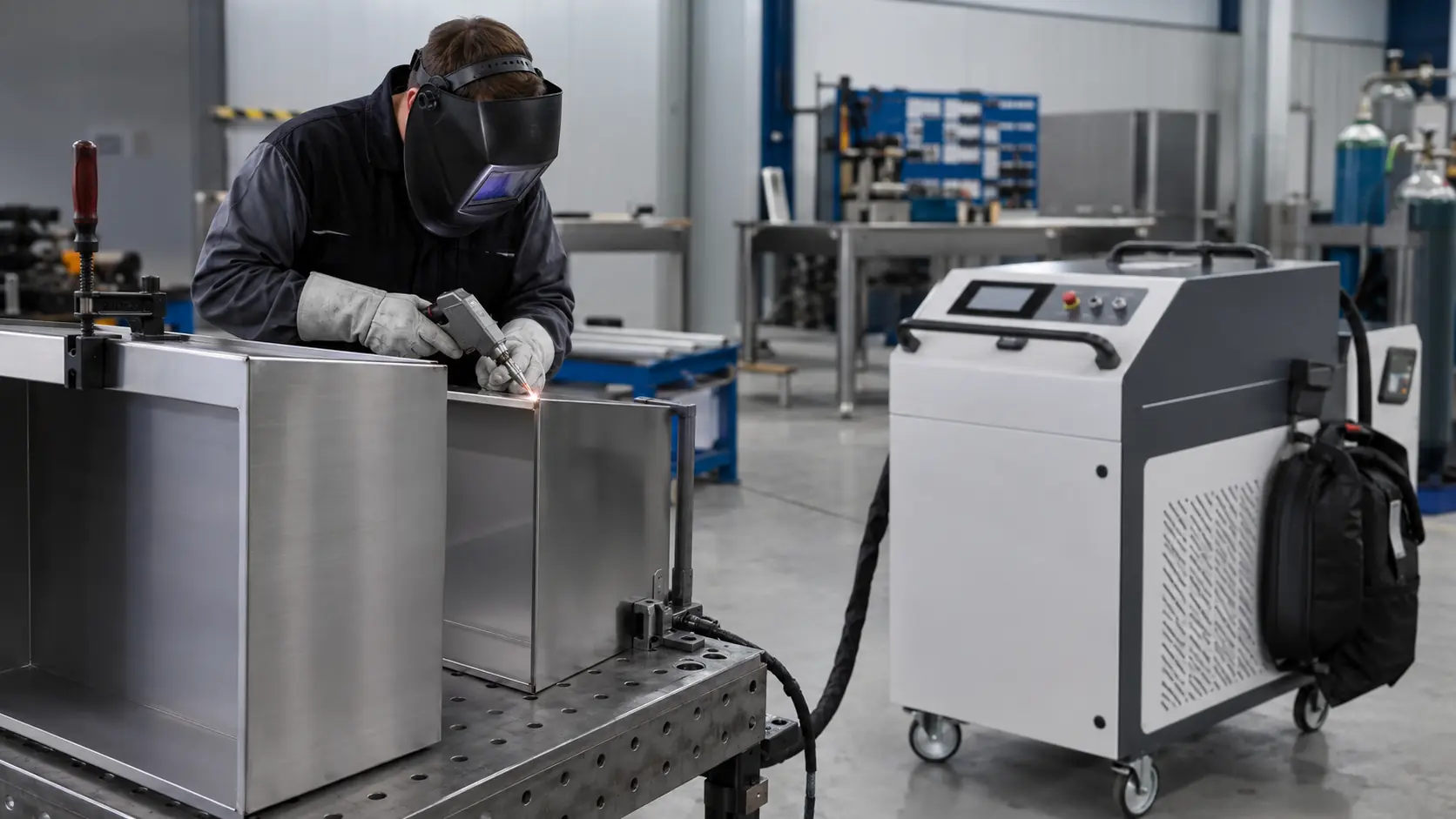
Choosing between a 1500W, 2000W, and 3000W handheld laser welding machine is not simply a matter of buying the highest available power. The right choice depends on the metal being welded, its actual thickness, joint design, required production speed, workshop power supply, and expected daily operating time.
A machine that is unnecessarily powerful can increase the initial investment and electrical requirements without creating meaningful benefits for thin-sheet production. On the other hand, choosing too little power for thick materials may reduce welding speed, penetration, and process stability.
This guide explains the practical differences between these three common power levels and helps metal fabricators, equipment distributors, and industrial buyers choose a suitable handheld laser welding machine for their production needs.
Why Laser Power Matters in Handheld Welding
Laser power affects how quickly energy can be delivered into the workpiece. With the correct settings, higher power can support faster travel speed or greater penetration, especially when welding thicker metal. However, power is only one part of the process.
The final weld also depends on:
- Material type and grade
- Workpiece thickness
- Butt, lap, corner, or fillet joint design
- Fit-up accuracy and joint gap
- Welding speed
- Wire-feeding requirements
- Shielding gas type and flow
- Required penetration and weld appearance
- Continuous operating time
For this reason, buyers should treat published thickness ranges as selection references rather than guaranteed results for every workpiece. A sample welding test using the buyer’s actual material is the most reliable way to confirm the final configuration.
Quick Comparison: 1500W vs 2000W vs 3000W
| Comparison | 1500W | 2000W | 3000W |
|---|---|---|---|
| Typical positioning | Thin-sheet and general fabrication | Versatile medium-power production | Thicker material and higher-output work |
| Stainless steel reference range | Approximately 0.5–3 mm | Approximately 0.5–4 mm | Approximately 0.5–6 mm |
| Carbon steel reference range | Approximately 0.5–3 mm | Approximately 0.5–4 mm | Approximately 0.5–6 mm |
| Aluminum alloy reference range | Approximately 1–2.5 mm | Approximately 1–3 mm | Approximately 1–5 mm |
| Best suited to | Light fabrication and thin products | Mixed jobs and regular production | Thicker parts and demanding output |
| Investment level | Lower | Medium | Higher |
| Power and cooling demand | Lower | Medium | Higher |
These values are general selection references based on the current MADE Laser handheld welding product range. Actual capacity depends on the material grade, joint, fit-up, travel speed, wire feeding, penetration requirement, and process settings.
When Should You Choose a 1500W Handheld Laser Welder?
A 1500W machine is often a practical entry point for businesses that mainly process thin stainless steel, carbon steel, galvanized sheet, or aluminum components. It can provide sufficient capacity for many common sheet-metal products without requiring the investment associated with a higher-power system.
Typical Applications
- Stainless steel cabinets and enclosures
- Kitchen equipment and sinks
- Doors, windows, and decorative metalwork
- Light metal furniture
- Electrical boxes and control cabinets
- Signs and thin sheet-metal products
- Small-batch repair and fabrication work
Main Advantages
The main advantages are lower purchase cost, easier adoption, and adequate performance for common thin-sheet applications. When the factory rarely welds material above approximately 3 mm, moving directly to a 3000W machine may not provide a proportionate return.
For workshops where mobility, compact size, and simple installation are more important than maximum thickness, an air-cooled handheld laser welding machine may also be worth evaluating. The current air-cooled range provides a compact alternative for suitable light and medium fabrication tasks.
When Is a 2000W Handheld Laser Welder the Better Choice?
A 2000W handheld laser welder is generally the most versatile option for buyers who process a broader mix of jobs. It provides additional capacity compared with a 1500W machine while remaining more economical and easier to deploy than a 3000W system.
Typical Applications
- Medium-volume sheet-metal production
- Stainless steel equipment manufacturing
- Metal frames, racks, and brackets
- HVAC components and duct-related fabrication
- Hardware and machinery covers
- Mixed-thickness contract manufacturing
- Workshops replacing multiple traditional welding tasks
Why Many Buyers Prefer 2000W
The 2000W class offers a useful balance among penetration, travel speed, equipment cost, and application range. It gives fabricators more flexibility when customer orders change between thin and medium materials.
For a job shop that handles many different products, this additional process margin can be more valuable than selecting a 1500W machine based only on the lowest current requirement. At the same time, a buyer who rarely processes heavier material may find that 2000W meets daily production needs without the additional infrastructure associated with 3000W.
When Is a 3000W Handheld Laser Welder Necessary?
A 3000W handheld laser welding machine is intended for buyers who regularly need greater penetration, higher welding speed on suitable medium-thickness parts, or more process capacity for demanding production.
Typical Applications
- Thicker stainless steel and carbon steel components
- Industrial equipment frames and housings
- Machinery components
- Heavy cabinets and enclosures
- Structural metal assemblies within the validated process range
- Higher-output production environments
What Buyers Should Confirm First
Higher laser power also creates greater requirements for electrical supply, cooling, safety control, parameter management, and operator discipline. Before choosing 3000W, confirm that the workshop can support the required input power and that the machine will actually be used on jobs that benefit from the additional capacity.
If most production consists of 1–2 mm stainless steel products, a 3000W system may be underused. If the factory repeatedly welds parts near the upper range of a 2000W machine, however, the additional process margin of 3000W may improve production stability.
Material Type Changes the Power Requirement
Stainless Steel
Stainless steel is one of the most common materials for handheld laser welding. It is widely used in kitchen equipment, cabinets, enclosures, doors, tanks, and decorative products. A 1500W system can cover many thin stainless steel jobs, while 2000W or 3000W becomes relevant as thickness or output requirements increase.
Carbon Steel
Carbon steel is used in frames, brackets, machinery covers, hardware, and industrial structures. Surface condition and joint preparation must be controlled because rust, oil, coating, or an inconsistent gap can affect weld stability.
Aluminum Alloy
Aluminum presents different welding challenges because of its thermal behavior, oxide layer, and reflectivity. It generally requires more careful parameter development and joint preparation than stainless steel. Buyers should not select power based on thickness alone; material grade and sample testing are especially important.
Galvanized Sheet
Galvanized sheet is common in cabinets, ducts, enclosures, and general sheet-metal work. The zinc coating can influence fumes, porosity, and seam quality, so ventilation, process control, and testing are necessary. The selected power must match both the base material and the actual joint design.
Copper and Highly Reflective Metals
Copper and some reflective alloys can be more difficult to weld consistently. Their suitability depends on the laser source, material grade, thickness, joint, and required result. Buyers processing these materials should send samples and drawings for evaluation instead of assuming that a standard thickness chart will apply.
Five Questions to Answer Before Selecting Power
1. What Is the Maximum Regular Thickness?
Do not select a machine based on the thickest part the factory might weld once a year. Identify the thickness used in normal daily production and the percentage of jobs at each thickness.
2. What Joint Types Do You Use?
A well-fitted butt joint does not behave the same as a fillet joint, lap joint, outside corner, or joint with a variable gap. Photos and drawings help the supplier evaluate whether autogenous welding is suitable or whether wire feeding is needed.
3. Is the Goal Penetration, Appearance, or Speed?
A decorative stainless steel product may prioritize a smooth visible seam and low distortion. An industrial assembly may require specified penetration and strength. High-volume production may prioritize cycle time. The same wattage cannot be evaluated without knowing the required result.
4. How Long Will the Machine Operate Each Day?
Occasional repair work and continuous factory production place different demands on cooling and system durability. Buyers should state the expected operating hours, batch size, and duty pattern when requesting a recommendation.
5. What Power Supply Is Available?
Confirm the local voltage, phase, frequency, and available electrical capacity before ordering. A mismatch between the selected machine and the workshop power supply can delay installation or create additional modification costs.
Do You Need an Automatic Wire Feeder?
Wire feeding can help bridge an appropriate joint gap, add filler material, and improve the appearance or consistency of certain welds. It is often useful when the workpieces do not have perfect fit-up or when the joint requires added material.
Before ordering, confirm:
- Base material
- Compatible filler wire
- Required wire diameter
- Single-wire or other feeding configuration
- Joint gap and preparation
- Whether the feeder is included in the quotation
A wire feeder does not compensate for poor part consistency in every situation. Stable fixturing and controlled joint gaps remain important.
Water-Cooled or Air-Cooled?
Power is not the only configuration decision. Buyers must also consider the cooling method.
Water-cooled machines are commonly used for fixed workshop production and are available in higher-power configurations. Air-cooled systems eliminate the separate water chiller, reducing size and simplifying movement and installation for suitable operating conditions.
The final choice should consider power level, ambient temperature, duty cycle, mobility, workshop space, maintenance expectations, and the manufacturer’s validated operating conditions—not cooling type alone.
When Should a Factory Consider Robotic Laser Welding?
Increasing wattage does not solve every production problem. If a factory produces standardized parts in repeated batches, the larger improvement may come from consistent positioning and automated path control.
A robotic laser welding machine can be a better long-term solution when:
- The same weld path is repeated continuously
- Product dimensions and joints are standardized
- Labor availability is a concern
- Consistent seam quality is essential
- The required output exceeds practical manual capacity
- The welding station must integrate with an automated line
Handheld welding remains more flexible for repair work, changing parts, small batches, and irregular products. Robotic welding is stronger where repeatability and production rhythm justify automation.
Common Buying Mistakes
Choosing Only by Maximum Thickness
A thickness chart does not describe joint quality, welding position, material grade, required penetration, or continuous production conditions. Use it to shortlist a machine, then validate the application.
Buying the Highest Power Without a Production Reason
More power is valuable only when the workpiece and output requirement use it. Otherwise, the buyer may pay more for equipment and supporting infrastructure without improving normal production.
Ignoring Fit-Up and Fixtures
Laser welding generally benefits from accurate part preparation and repeatable positioning. Variable gaps and unstable workpieces can create inconsistent results regardless of machine power.
Requesting a Price Without Application Information
A useful quotation should match the laser source, welding head, cooling system, wire feeder, fiber length, electrical standard, accessories, and service scope to the actual job. A price without a clear configuration is difficult to compare.
Failing to Verify Service and Consumables
Before purchase, confirm warranty coverage, remote support, training, spare parts, protective lenses, nozzles, wire-feeder parts, and expected replacement intervals.
What to Send the Supplier Before Requesting a Quote
To receive a more accurate recommendation, prepare the following information:
- Material name and grade
- Minimum and maximum thickness
- Workpiece drawings or clear photos
- Joint type and joint-gap range
- Required penetration and seam appearance
- Whether filler wire is required
- Part size and approximate weight
- Daily production quantity
- Expected operating hours
- Local voltage, phase, and frequency
- Destination country
MADE Laser supplies different laser welding machine configurations for manual and automated metal fabrication. Sending complete application details helps the technical team recommend an appropriate power level instead of relying on a generic machine price.
Final Recommendation
Choose 1500W when your production is mainly thin sheet metal and you want an economical, practical solution for general fabrication. Choose 2000W when you need greater flexibility across thin and medium materials and want a balanced machine for regular workshop production. Choose 3000W when thicker materials, higher output, or greater process margin are recurring requirements—not occasional exceptions.
The best machine is not automatically the one with the highest wattage. It is the system whose laser power, cooling method, welding head, wire feeder, electrical requirements, and service package match the real production process.
Need Help Selecting the Right Laser Welder?
Send MADE Laser your material, thickness, joint photos or drawings, daily output, and local power supply. Our team can help evaluate whether a 1500W, 2000W, or 3000W configuration is more suitable for your application.
Contact MADE Laser for a machine recommendation and quotation.
Frequently Asked Questions
Is a 1500W laser welder enough for stainless steel?
It can be suitable for many thin stainless steel products, with the current MADE Laser reference range extending to approximately 3 mm under appropriate conditions. The joint, penetration requirement, travel speed, and fit-up must still be evaluated.
Is 2000W the best general-purpose choice?
For many mixed-production workshops, 2000W provides a useful balance of capability, flexibility, and investment. It is not automatically ideal for every factory, so the decision should still be based on regular material and thickness requirements.
Can a 3000W machine weld thin metal?
Yes, when the machine supports suitable parameter adjustment and the process is properly controlled. However, buying 3000W only for thin sheet production may add cost and complexity without delivering a proportionate advantage.
Does higher power always mean faster welding?
No. Higher available power can support faster processing in suitable applications, but actual speed is limited by material, joint design, penetration, seam quality, wire feeding, operator control, and production safety.
Should I test my samples before ordering?
Yes. A sample test using the actual material, thickness, joint, and quality requirement is one of the best ways to confirm power selection and establish realistic expectations before purchase.