

Many buyers assume the main question is whether the machine can mark aluminum at all.
That is usually not the real problem.
The real problem is whether the machine can produce the right mark on your aluminum part at the required speed, with stable results in batch production.
That is where many quotations start to look less accurate.
For aluminum applications, the first check should not be machine price alone.
It should be the combination of surface condition, mark requirement, production target, and part handling method.
If these points are not clear at the beginning, even a machine that “can mark aluminum” may still be the wrong machine for the job.
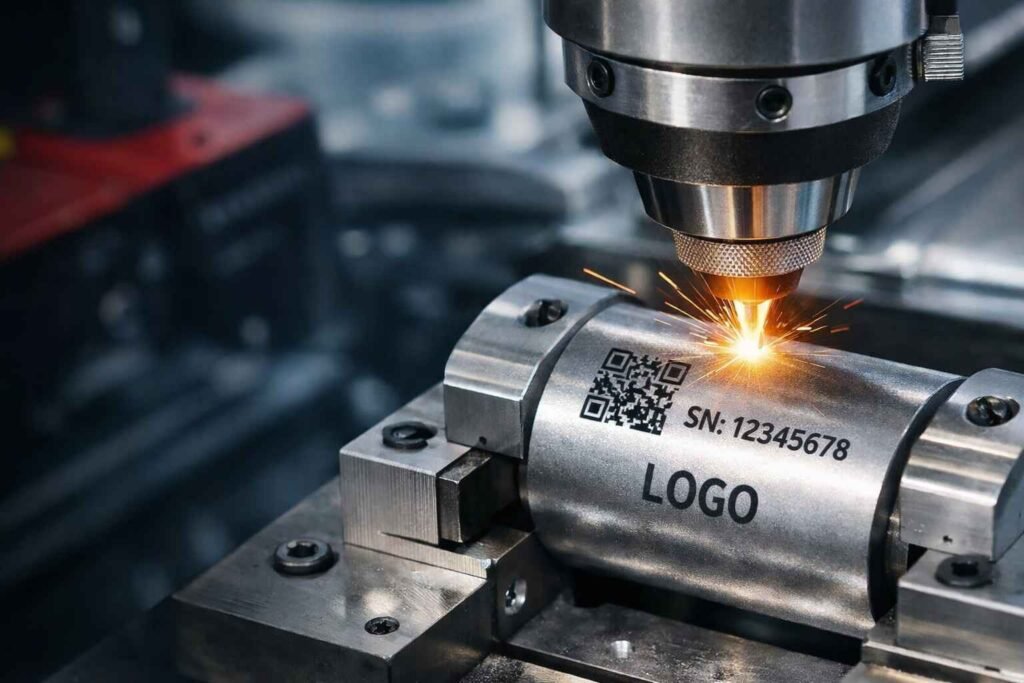
1. Check what kind of aluminum you are actually marking
This is the first thing buyers should confirm.
“Aluminum” is too broad for machine selection.
In real production, the marking result can change a lot depending on whether the part is:
- bare aluminum
- anodized aluminum
- coated aluminum
- brushed aluminum
- polished aluminum
- cast or machined aluminum
These are not small differences.
For example, a supplier may show a very clean sample on anodized aluminum, but your actual job may be raw machined parts.
A machine that gives strong visual contrast on one surface may give a lighter or less consistent result on another.
Before asking for a quotation, buyers should prepare this information:
- material type
- surface finish
- whether the part is flat or curved
- whether the part is clean, coated, oxidized, or uneven
- whether all batches use the same aluminum condition
This one step can eliminate many wrong recommendations early.
2. Clarify whether you need marking, etching, or deeper engraving
A lot of buyers use the word “engraving” for every metal mark.
That creates confusion.
In purchasing terms, these are different jobs:
- surface marking for logo, text, code, or traceability
- light etching for a visible but shallow mark
- deeper engraving for stronger recess, durability, or more obvious touch feel
These three requirements should not be quoted in the same way.
If your real target is serial numbers and QR codes, the focus is usually on:
- readability
- contrast
- line sharpness
- repeatability
- speed per part
If your real target is deeper engraved branding or permanent recessed identification, then power choice, cycle time, and process setup change immediately.
This is one of the most common reasons why two quotations for “aluminum laser marking” may look similar on paper but perform very differently in production.
3. Do not choose power by habit
This is one of the most common buying mistakes.
Some buyers ask directly for 50W because it sounds safer.
Others choose 20W only to reduce budget.
Neither decision is reliable unless the application is already clear.
Power should be matched to the actual job.
When a lower-power setup may already be enough
For small logos, text, serial numbers, and standard code marking on aluminum parts, a lower or mid-range configuration may already meet the need if:
- the mark area is small
- the required depth is limited
- the daily output is moderate
- the code size is not extremely small
- the surface condition is stable
When a higher-power setup becomes more reasonable
A higher-power configuration becomes more attractive when buyers need:
- faster cycle times
- larger filled logos
- wider marking areas
- more aggressive material removal
- deeper engraved results
- heavier daily production loads
The key point is simple:
Higher power does not automatically mean better results.
In many aluminum jobs, it mainly means more speed margin or more engraving capacity.
So the better question is not “Which wattage is best?”
It is:
What mark result do I need, and how many parts do I need to process per shift?
4. QR code marking and logo marking are not the same task
This point is often ignored in low-quality articles.
A machine that can mark a large logo on aluminum is not automatically the best choice for very small QR codes or compact serial data.
Why?
Because these jobs place different pressure on the process:
For logo marking
Buyers usually care more about:
- visual uniformity
- filled-area speed
- contrast consistency
- edge cleanliness
For serial numbers and small text
Buyers usually care more about:
- line sharpness
- character clarity
- stroke consistency
- readability under lighting variation
For QR codes and Data Matrix codes
Buyers should pay special attention to:
- minimum readable code size
- module clarity
- scanning success rate
- repeatability across batches
- consistency after handling or surface variation
This means buyers should send the supplier the actual code size requirement, not just say “we need code marking.”
That small detail changes machine recommendation more than many buyers expect.
5. The marking field matters more than many buyers think
A machine may be technically able to mark the part, but still be inefficient in real use if the field size is wrong.
This usually becomes a problem in these cases:
- large aluminum housings
- multiple parts placed in one fixture
- long part numbers or long code layouts
- jobs where operators want to mark several parts in one cycle
If the field is too small, production becomes slower because:
- the operator has to reposition parts more often
- batch fixture layout becomes limited
- the usable marking area is less efficient
- the workflow becomes less smooth than expected
This is why buyers should check early:
- single-part mark size
- maximum part size
- whether one-cycle multi-part marking is needed
- whether future part sizes may become larger
- whether the current lens setup matches the actual work area
A cheap quotation can lose its advantage quickly if the selected field does not fit the production layout.
6. Fixture design is often the hidden difference between demo results and factory results
This is a very important buying point.
Many suppliers focus only on the machine body, laser source, and software.
But in actual production, aluminum marking consistency often depends heavily on fixture quality.
This is especially true for:
- small machined parts
- curved housings
- thin aluminum plates
- irregular hardware parts
- batch-loaded components
A poor fixture causes problems such as:
- unstable focus height
- inconsistent mark position
- slower loading and unloading
- operator errors
- lower cycle efficiency
That is why buyers should ask these questions before confirming the order:
- Is a standard fixture enough?
- Does this part need a customized jig?
- Will batch marking be required?
- Is a rotary device needed for round parts?
- How will repeat positioning be controlled?
A machine may look good in a sample video, but if the fixture side is not solved, production stability may still be weak.
7. Ask how stable the result is across real batch variation
This is where more serious buyers separate themselves from casual buyers.
Do not only ask whether the machine can mark one sample.
Ask whether it can mark 50 parts, 200 parts, or one full production batch with stable readability.
This matters because aluminum parts often vary in small but important ways:
- surface reflectivity
- brushing direction
- anodized layer consistency
- flatness
- coating thickness
- machining finish
Even when the material name stays the same, the visible result may shift.
So buyers should not stop at “Can you mark this material?”
They should ask:
- Will the same settings work across all batches?
- What variation usually affects the result?
- Will parameter adjustment be needed often?
- How is the machine tested before shipment?
These are much better buying questions than simply asking for the lowest price.
8. Sample testing should be based on your real parts, not only generic samples
If a supplier sends a beautiful aluminum sample, that is useful — but not enough.
The better approach is to test on your actual parts or on parts that match your real application closely.
A proper sample test should confirm:
- mark visibility
- contrast quality
- text sharpness
- code readability
- depth if required
- speed per part
- stability across multiple pieces
If your project is important, ask for more than one result where needed, such as:
- different power options
- different mark depths
- different code sizes
- different surface finishes
That gives you a much more practical basis for choosing the configuration.
9. Do not compare quotations without comparing production assumptions
This is another frequent mistake.
Two suppliers may both quote a “fiber laser marking machine for aluminum,” but their assumptions may be completely different.
One quotation may assume:
- basic text marking
- one part at a time
- moderate output
- flat parts only
- no fixture customization
Another quotation may include:
- code marking
- higher speed expectations
- batch fixture support
- larger field requirement
- deeper engraving ability
So before deciding which quotation is better, buyers should compare:
- target mark type
- target output
- aluminum surface condition
- field size
- fixture scope
- software or control scope
- after-sales support level
A low quotation is not automatically a better quotation.
10. What buyers should send before asking for price
If you want a supplier to recommend the right setup faster, send the right information first.
At minimum, buyers should provide:
- aluminum part photos
- drawing or dimensions
- surface type
- mark content
- mark size
- required depth or contrast
- expected daily output
- whether QR code or serial marking is needed
- whether fixtures or rotary marking are needed
- whether the machine is for trial use or batch production
This reduces wrong recommendations and makes the quotation more realistic.
Common buying mistakes in aluminum laser marking projects
Before placing an order, buyers should actively avoid these mistakes:
Mistake 1: Choosing power before defining the mark
The supplier cannot recommend the right configuration if the real mark target is still unclear.
Mistake 2: Treating all aluminum surfaces as the same
Bare, anodized, coated, and polished aluminum should not be treated as one identical marking condition.
Mistake 3: Looking only at a single sample photo
A sample photo does not show batch stability, cycle efficiency, or fixture quality.
Mistake 4: Ignoring QR code readability requirements
A visible code is not always a reliably scannable code.
Mistake 5: Comparing quotations without comparing assumptions
Price comparison is weak if the production scope is not aligned first.
A simple rule buyers can use
If a supplier starts by asking about:
- aluminum surface
- mark type
- code size
- depth requirement
- production target
- part positioning method
that is usually a good sign.
If a supplier gives a recommendation too quickly without asking those questions, the quotation may be incomplete.
Conclusion
For aluminum laser marking projects, the first thing buyers should check is not just whether the machine can mark aluminum.
They should check whether the machine can produce the required mark quality, on the actual aluminum surface, at the required production pace, with a stable setup for repeated use.
That is the difference between buying a machine that looks fine in a quotation and buying one that actually works well in production.
If you are sourcing a fiber laser marking machine for aluminum parts, it is better to send your part photos, dimensions, marking content, and expected output before asking for a final recommendation. That makes it much easier to match the machine configuration to the real job.
FAQ
1. Can a fiber laser marking machine mark aluminum parts clearly?
Yes, but the final result depends heavily on the aluminum surface type, the required mark, and the production setup. Bare, anodized, brushed, and coated aluminum can produce different marking results.
2. Is 50W always better than 20W or 30W for aluminum marking?
Not always. Higher power is often more useful for faster production, larger filled marks, or deeper engraving. For many standard marking jobs, a lower or mid-range setup may already be enough.
3. What should I check first when buying a laser marker for aluminum?
The first checks should be the aluminum surface condition, the required marking result, the code or logo size, the output target, and whether fixture customization is needed.
4. Why do some aluminum parts mark well in samples but not in batch production?
Because real production introduces variation in surface finish, positioning, focus consistency, and part handling. A good sample result does not automatically guarantee stable batch performance.
5. Is logo marking the same as QR code marking on aluminum?
No. Logo marking focuses more on visual appearance, while QR code marking also depends strongly on line quality, code size, and scanning reliability.
6. Do I need a custom fixture for aluminum laser marking?
If the parts are small, thin, curved, irregular, or batch-loaded, a custom fixture can improve positioning accuracy and production efficiency significantly.