

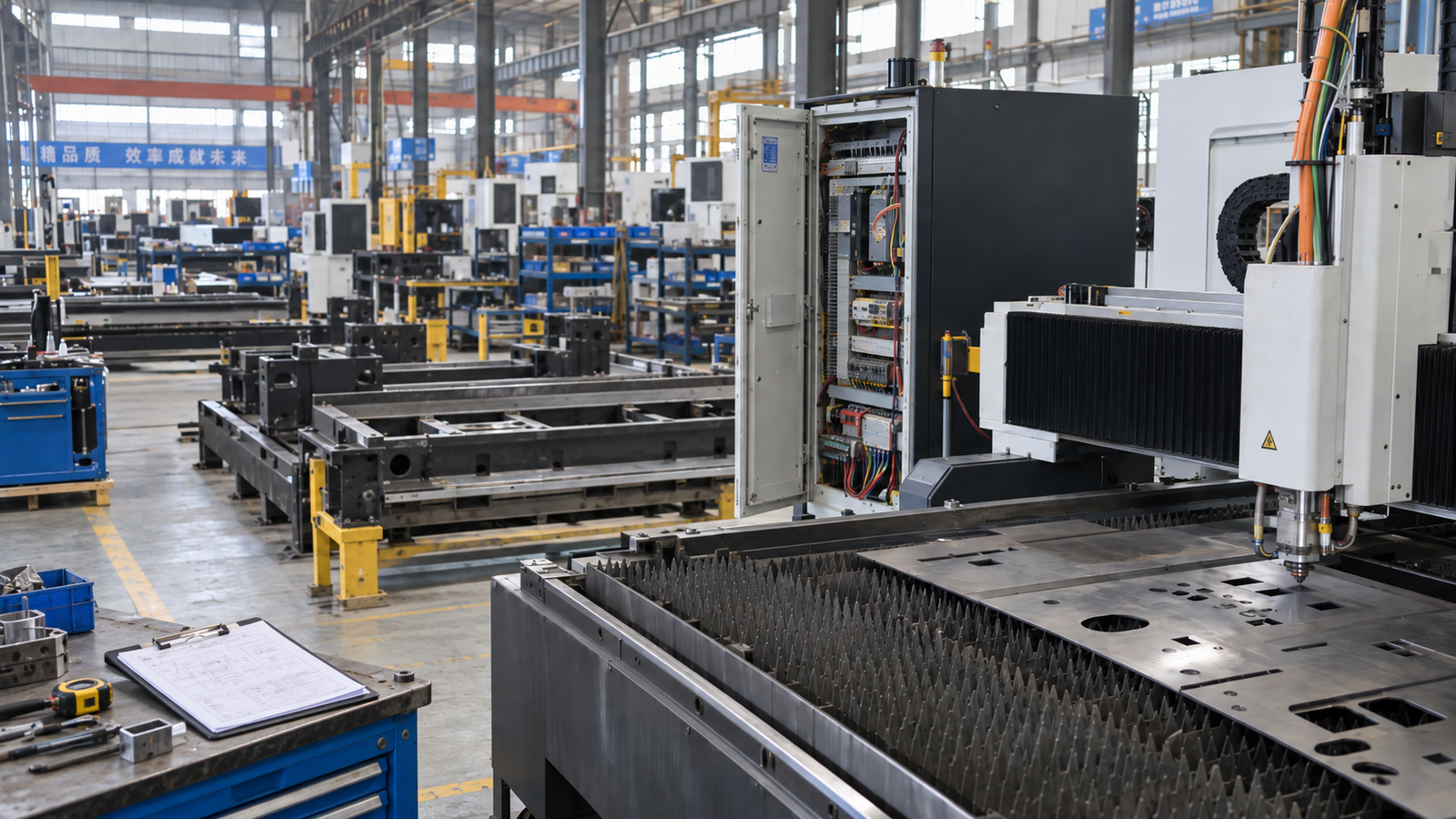
Buying a fiber laser cutting machine is not simply a matter of comparing laser power and machine prices.
For overseas buyers, the more important question is whether the supplier can provide a machine configuration that matches the actual production requirement and then support that machine through testing, shipment, installation and long-term operation.
Two machines may both be described as a 3000W fiber laser cutter, but their machine structure, cutting head, control system, electrical configuration, installation requirements and after-sales support can be very different.
This guide explains the practical checks that manufacturers, metal fabrication companies and equipment distributors should make before placing an order for a fiber laser cutting machine.
1. Start With Your Application, Not the Machine Price
A professional supplier should first try to understand what the machine will actually be used for.
Before discussing a quotation, prepare basic production information such as:
- Material type
- Normal material thickness
- Maximum required thickness
- Standard sheet dimensions
- Main part types
- Required production volume
- Daily operating hours
- Available assist gas
- Factory voltage and frequency
- Available workshop space
If drawings or representative parts are available, these are also useful for machine selection and test cutting.
A supplier that recommends the highest available laser power without first understanding the application may not be providing the most economical solution.
For example, a sheet metal workshop processing mainly thin stainless steel may have very different priorities from a heavy fabrication company processing thicker carbon steel plates.
You can review different fiber laser cutting machine configurations before deciding which machine structure is more suitable for your production process.
2. Ask for a Complete Machine Configuration
Do not evaluate a quotation only by the words “1500W,” “3000W” or “6000W.”
The laser source is only one part of the complete machine.
A useful quotation should clearly identify the main components and configuration, including:
- Laser source brand and power
- Laser cutting head
- Control system
- Servo motors and drives
- Machine bed
- Guide rails and transmission system
- Chiller
- Automatic lubrication system
- Voltage stabilizer, where required
- Dust extraction arrangement
- Assist gas system requirements
- Working area
- Exchange table configuration, if included
This information makes quotations easier to compare and reduces the risk of discovering important differences after an order is placed.
Do Not Compare Two Quotations Only by Price
When one machine is significantly cheaper than another, check which parts of the configuration are different.
The difference may come from the laser source, cutting head, drive system, machine structure, electrical components, included accessories or service package.
| Item | Supplier A | Supplier B | What to Check |
|---|---|---|---|
| Laser Power | 3000W | 3000W | Laser source brand and model |
| Working Area | 3015 | 3015 | Effective processing area |
| Cutting Head | Specified | Specified | Model and autofocus capability |
| Control System | Specified | Specified | Software functions and compatibility |
| Table | Single | Exchange | Effect on loading and production workflow |
| Service | Included | Included | What the service actually includes |
3. Decide Whether You Really Need an Exchange Table
Machine structure should match production volume.
A single-table fiber laser cutting machine can be suitable for workshops with moderate production requirements, smaller batches or situations where initial investment is an important consideration.
A double-worktable laser cutting machine, on the other hand, allows material handling to take place while the other table is involved in processing.
This can be valuable when machine utilization and production continuity are important.
However, an exchange table should not automatically be considered the better choice for every buyer.
The correct question is whether the additional loading and unloading efficiency will provide real value in your daily production.
A good supplier should be able to discuss this based on expected batch size and operating hours rather than simply encouraging the buyer to choose the more expensive configuration.
4. Request Test Cutting With Your Actual Material
Catalog specifications provide useful reference information, but they cannot fully demonstrate how a machine will perform on your particular components.
When possible, provide the supplier with:
- Your actual material
- Representative thicknesses
- DXF or other suitable part drawings
- Important holes or contours
- Any special edge-quality requirements
A representative test is normally more useful than watching the machine cut a demonstration pattern selected by the supplier.
What Should You Examine on a Test-Cut Part?
Depending on the material and application, buyers can examine:
- Overall cut consistency
- Edge condition
- Dross formation
- Hole quality
- Small-feature processing
- Corner performance
- Dimensional consistency
- Heat influence around the cut
The purpose is not to find an unrealistic “perfect” sample. The purpose is to understand whether the machine and selected parameters can meet the requirements of your production process.
5. Ask How the Machine Is Tested Before Shipment
Pre-shipment testing is one of the most important parts of an overseas equipment order.
Once a machine has arrived in another country, correcting configuration or assembly problems becomes much more complicated and expensive.
Before shipment, ask the supplier what tests are normally performed.
A practical inspection process may include checks of:
- Machine movement
- Cutting operation
- Control system functions
- Laser source operation
- Cutting head functions
- Cooling system
- Lubrication system
- Electrical cabinet
- Safety functions
- Automatic table exchange, when applicable
- Supporting accessories
Buyers can also ask for photographs or videos showing the completed machine and its operation before packing.
6. Check the Supplier's Manufacturing and Technical Capability
A professional website is useful, but an industrial equipment buyer should also try to understand what is actually behind the website.
Useful questions include:
- Where is the machine assembled?
- Can the supplier show current workshop photographs or videos?
- Who performs machine commissioning?
- Can technical staff explain the machine configuration?
- Can the supplier perform sample cutting?
- How are machines inspected before shipment?
- Which components are normally kept as spare parts?
Overseas buyers who cannot visit the factory can request a live video call showing the production area and a specific machine.
This can provide significantly more useful information than relying only on promotional photographs.
You can also learn more about MADE Laser and our laser equipment business before discussing a machine project with our team.
7. Confirm the Electrical Configuration Before Production
Electrical requirements vary between countries and factories.
Before the machine enters production, confirm:
- Required voltage
- Frequency
- Number of phases
- Factory power capacity
- Grounding requirements
- Whether a voltage stabilizer is recommended
This information should be discussed before shipment rather than after the machine arrives.
The buyer should also understand the power requirements of supporting equipment such as the chiller, air compressor, extraction system and other accessories.
8. Understand the Assist-Gas Requirement
The laser cutting machine itself is only part of the operating system.
Different cutting applications may use oxygen, nitrogen or compressed air depending on the material, thickness and required cut quality.
Before ordering, discuss:
- Which gas will be used for the main materials
- Required gas pressure
- Local gas availability
- Gas consumption considerations
- Required compressor or gas supply equipment
A buyer should therefore calculate operating conditions rather than considering only the purchase price of the laser machine.
9. Ask What Is Included in Installation and Training
“Installation included” can mean different things from different suppliers.
Before ordering, clarify exactly what technical support is provided.
Ask whether support includes:
- Machine installation guidance
- Control software training
- Cutting parameter setup
- Routine maintenance training
- Remote troubleshooting
- On-site engineering service when required
- Operating manuals
- Electrical documentation
Also confirm whether any travel, accommodation or service charges apply if an engineer needs to visit the customer's factory.
10. Understand Spare Parts and Consumable Requirements
Every laser cutting machine requires routine consumables and maintenance items.
Before shipment, ask which parts should normally be kept at the factory.
Depending on the machine configuration, common items may include:
- Cutting nozzles
- Protective lenses
- Ceramic rings
- Filters
- Lubrication materials
- Other cutting-head consumables
The exact spare-parts requirement depends on the machine and cutting-head configuration.
Buyers should also ask:
- Where replacement parts can be purchased
- Typical spare-part lead times
- Which parts are recommended for the initial shipment
- Which components are covered by warranty
11. Review Packing and Shipment Before the Machine Leaves the Factory
International shipment introduces risks that do not exist in domestic machine delivery.
A fiber laser cutting machine may travel by truck, port handling and sea freight before reaching the buyer's factory.
Before shipment, confirm how the machine and its accessories will be protected.
Important points include:
- Machine protection and wrapping
- Moisture protection
- Accessory identification
- Loose-part packaging
- Loading arrangement
- Shipping marks
- Packing list
- Required export documents
It is also useful to request photographs during packing and container loading.
12. Evaluate the Supplier's After-Sales Response Process
Technical support should be discussed before purchasing the machine, not only after a problem occurs.
Ask the supplier what happens if the machine stops working.
- Who should the operator contact?
- What information should be provided for diagnosis?
- Can engineers connect remotely to the control system?
- How are replacement parts shipped?
- What support is available after the warranty period?
A clear support process is particularly important for buyers operating the machine thousands of kilometers away from the equipment manufacturer.
13. Be Careful With Cutting-Thickness Claims
Maximum cutting thickness is frequently used as a marketing specification, but buyers should not use this number alone when selecting laser power.
There is an important difference between:
- Occasionally being able to cut a particular thickness
- Cutting that thickness efficiently every day in production
If your factory normally processes a particular thickness, tell the supplier that it is your regular production thickness, rather than simply asking whether the machine can cut it.
This helps the supplier discuss a configuration around real production requirements instead of theoretical maximum capability.
14. Fiber Laser Cutting Machine Pre-Purchase Checklist
Before confirming an order, overseas buyers can use the following checklist.
| Check | Confirmed? |
|---|---|
| Main material and normal thickness range | □ |
| Required laser power | □ |
| Working area | □ |
| Single or exchange table | □ |
| Laser source model | □ |
| Cutting head | □ |
| Control system | □ |
| Voltage and frequency | □ |
| Assist-gas arrangement | □ |
| Sample cutting completed | □ |
| Pre-shipment machine test | □ |
| Installation and training scope | □ |
| Warranty terms | □ |
| Spare parts and consumables | □ |
| Packing and shipment method | □ |
| After-sales contact process | □ |
What Information Should You Send to a Laser Machine Supplier?
A detailed inquiry normally produces a more useful machine recommendation than simply asking, “What is your price for a 3000W laser cutter?”
For a faster technical evaluation, send:
- Material: Stainless steel, carbon steel, aluminum or other metal
- Regular thickness: Your most frequently processed range
- Maximum thickness: Occasional cutting requirement
- Sheet size: Standard material dimensions
- Production volume: Approximate daily or monthly requirement
- Drawings: Representative DXF drawings when possible
- Factory power supply: Voltage, frequency and phase
- Destination: Country and delivery location
Final Thoughts
The best fiber laser cutting machine supplier is not necessarily the company offering the highest laser power or the lowest quotation.
For an industrial buyer, a better supplier is one that can understand the production requirement, explain the machine configuration, demonstrate cutting performance, prepare the machine correctly before shipment and provide a practical support process after delivery.
Taking the time to verify these points before purchasing can reduce misunderstandings and help buyers select equipment based on actual production needs rather than marketing specifications alone.
If you are currently evaluating a fiber laser cutting machine, send MADE Laser your material, thickness range, sheet size, representative drawings and production requirements through our contact page. We can discuss a suitable machine configuration based on your application.