

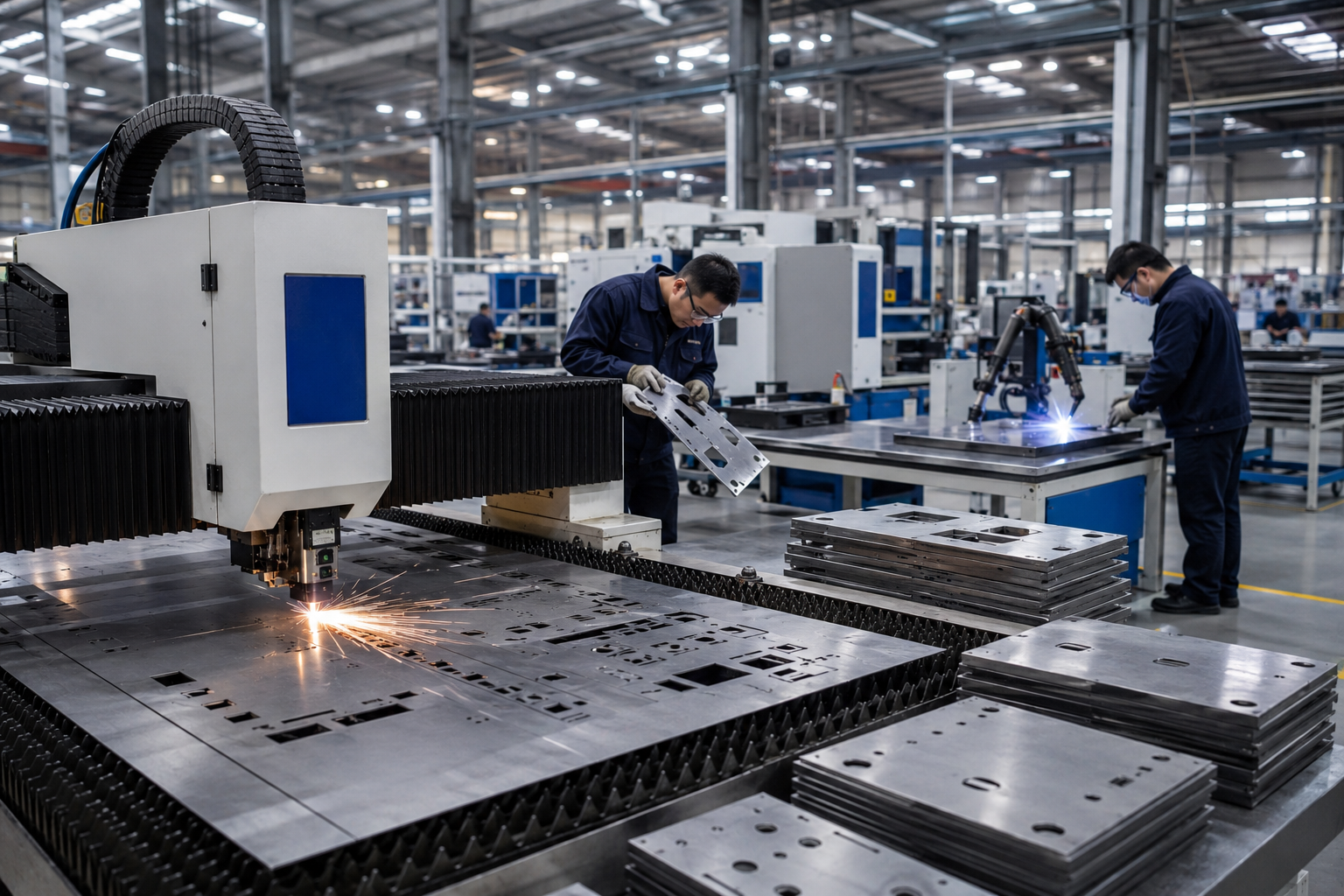
Metal fabrication requirements vary significantly between industries. A workshop producing stainless steel enclosures, an automotive parts supplier, and a hardware manufacturer may all process metal materials, but their requirements for cutting, welding, and marking are different.
Choosing a suitable laser machine is not only about selecting a laser power or machine model. Manufacturers need to consider material type, production volume, processing requirements, accuracy expectations, and future production plans.
For companies investing in laser processing equipment, understanding these factors before purchasing can help reduce unnecessary costs and improve long-term production efficiency.
Understanding Different Laser Processing Requirements
In metal fabrication, laser equipment is mainly used for three important processes:
- Metal cutting
- Metal welding
- Metal marking and identification
Each process solves a different manufacturing challenge.
A fiber laser cutting machine is commonly used for sheet metal processing, profiles, and precision cutting applications. A handheld laser welding machine helps manufacturers improve welding efficiency for stainless steel, carbon steel, aluminum, and other metals. Fiber laser marking machines are widely applied for permanent identification, serial numbers, QR codes, and product traceability.
Before choosing equipment, manufacturers should first identify which production process needs improvement.
Choosing a Fiber Laser Cutting Machine for Metal Processing
Laser cutting is often the first step in metal fabrication.
Manufacturers should evaluate several key factors:
1. Material Type and Thickness
Different materials have different cutting characteristics.
Common materials include:
- Stainless steel
- Carbon steel
- Aluminum
- Brass
- Copper
Material thickness directly affects laser power selection, cutting speed, and processing stability.
For example, a factory mainly producing thin stainless steel sheets may have different requirements from a manufacturer processing thicker carbon steel components.
The right approach is to evaluate actual production materials instead of selecting equipment only based on maximum specifications.
2. Production Volume and Working Area
The machine configuration should match production requirements.
Important questions include:
- How many parts are processed daily?
- What is the maximum sheet size?
- Is continuous production required?
- Is automation needed?
For small and medium production environments, a standard working table may meet requirements. For higher-volume manufacturing, features such as exchange tables or automated loading systems may improve production efficiency.
Selecting a Handheld Laser Welding Machine
Welding requirements are often more complex because they depend on:
- Material compatibility
- Joint design
- Appearance requirements
- Operator experience
- Production volume
Handheld laser welding machines are commonly considered by manufacturers looking to improve welding speed, reduce post-processing work, and achieve consistent weld appearance.
However, laser welding is not intended to replace every traditional welding process.
TIG and MIG welding may still be suitable for certain applications, especially when dealing with specific structures, very thick materials, or projects with different investment requirements.
The correct selection depends on the actual application.
Questions Manufacturers Should Ask Before Buying a Laser Welding Machine
Before purchasing, buyers should confirm:
Material Requirements
- What metals need to be welded?
- What are the typical thickness ranges?
- Are there surface coatings or special treatments?
Production Requirements
- How many working hours per day?
- Is the production batch small or large?
- Is manual operation or automation preferred?
Equipment Configuration
- What laser source is used?
- What welding head configuration is included?
- What cooling system is suitable?
A proper supplier should be able to discuss these factors based on the customer's actual application instead of recommending a machine only from a product catalog.
Using Fiber Laser Marking for Product Identification
Many manufacturers need permanent identification on metal parts.
Typical marking requirements include:
- Product numbers
- Serial numbers
- QR codes
- Barcodes
- Logos
- Batch information
Fiber laser marking machines are widely used for marking metals such as stainless steel, aluminum, brass, and other industrial materials. They are commonly applied in industries where permanent identification and traceability are important.
For manufacturers, laser marking is not only about adding a logo. It can become part of quality management and production tracking systems.
What Manufacturers Should Prepare Before Contacting a Laser Equipment Supplier
Providing detailed production information helps suppliers recommend a more suitable configuration.
Useful information includes:
Material Information
- Material type
- Thickness
- Surface condition
Production Information
- Daily production quantity
- Required processing speed
- Current manufacturing challenges
Product Information
- Product drawings
- Photos
- Required processing results
Factory Conditions
- Available space
- Power supply
- Operator experience
The more accurate the application information, the easier it is to evaluate whether a machine configuration matches the production requirement.
Why Application Testing Matters Before Ordering
Laser processing performance depends on many variables.
Two factories using the same material may require different parameters because of differences in:
- Product design
- Surface condition
- Processing speed
- Quality requirements
For this reason, application testing is an important step before final equipment selection.
A practical evaluation should include:
- Actual material samples
- Required processing effect
- Processing speed
- Final product quality
Testing helps manufacturers understand expected results before making an equipment investment.
Building a Long-Term Laser Processing Solution
Selecting a laser machine is not only about the equipment itself.
Manufacturers should also consider:
- Technical support
- Spare parts availability
- Operator training
- Maintenance requirements
- Future production expansion
A suitable laser solution should support current manufacturing needs while allowing flexibility for future projects.
FAQ
What laser machine is suitable for metal fabrication?
It depends on the production process. Fiber laser cutting machines are used for metal cutting, laser welding machines are used for joining metal parts, and fiber laser marking machines are used for permanent identification.
How do I choose the right laser power?
Laser power selection depends on material type, thickness, production speed requirements, and application conditions.
Can one laser machine handle different metals?
Many laser machines can process multiple metal types, but performance depends on material characteristics and machine configuration.
Should I test materials before buying a laser machine?
Yes. Testing actual materials helps confirm processing parameters and expected results before investment.