

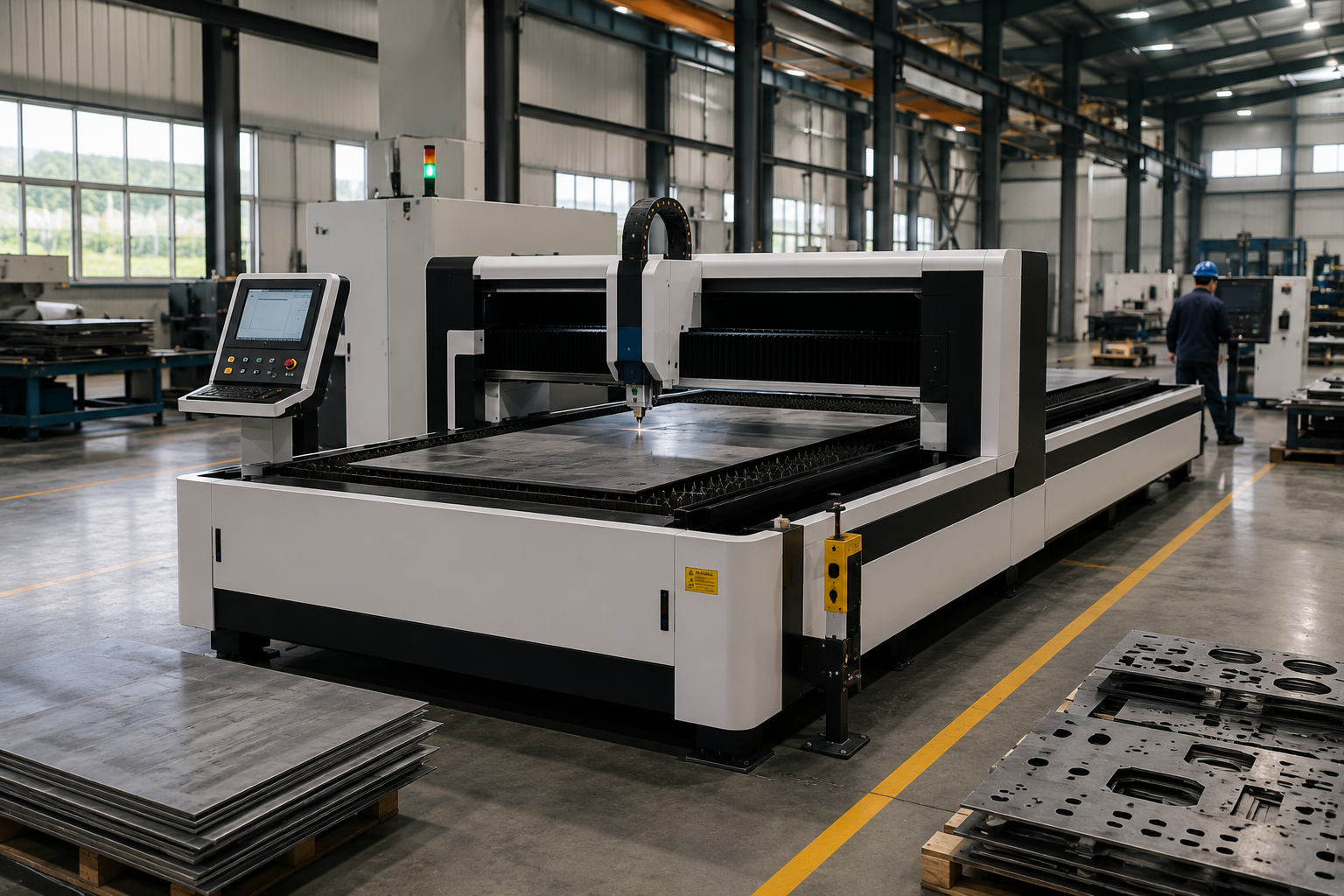
Single Table vs Double Worktable Laser Cutting Machine: Quick Comparison
| Comparison Point | Single Table Machine | Double Worktable Machine |
|---|---|---|
| Machine structure | One fixed cutting table | Two alternating worktables |
| Loading and cutting | Normally completed in sequence | Loading can occur while the other table is cutting |
| Initial investment | Generally more accessible | Generally higher due to the exchange-table structure |
| Machine footprint | More compact | Requires more floor space and loading clearance |
| Mechanical complexity | Simpler | Includes an additional table and exchange system |
| Production workflow | Suitable for intermittent or varied production | Suitable for continuous sheet-metal production |
| Typical buyer | Small and medium workshops, job shops and first-time buyers | Growing factories and higher-volume manufacturers |
| Main purchasing priority | Practical cutting capacity with controlled investment | Reduced loading downtime and higher machine utilization |
This comparison assumes that laser power, processing area and core component quality are similar. A well-configured single table machine may be more suitable than a poorly matched double worktable machine.
What Is a Single Table Fiber Laser Cutting Machine?
A single table fiber laser cutting machine uses one working platform for sheet loading, laser cutting and finished-part unloading. After a cutting cycle is complete, the operator removes the cut parts and scrap before preparing the next sheet.
Its simpler layout can make it practical for factories that do not require uninterrupted sheet processing.
Buyers can review the current
MADE Laser single table fiber laser cutting machine
for metal-sheet cutting applications.
Main Advantages of a Single Table Machine
- More compact machine layout
- Lower structural complexity
- More accessible initial investment
- Easier placement in workshops with limited floor space
- Straightforward loading and unloading process
- Suitable for varied and small-batch orders
- Practical for factories purchasing their first laser cutter
Possible Limitations
- Cutting normally stops during unloading and reloading
- Machine utilization may decrease when handling time is long
- It may not be the most efficient structure for continuous high-volume production
- Heavy or large sheets may require additional loading equipment
Applications That Often Suit a Single Table Machine
- Custom sheet-metal fabrication
- Electrical cabinets and enclosures
- Metal furniture components
- Advertising and signage products
- Decorative metal panels
- Hardware and general industrial parts
- Prototype and small-batch production
- Contract cutting workshops processing varied orders
Practical consideration: A single table machine may provide better value when the operator already needs time to sort parts, remove slag, identify different customer orders or prepare drawings between cutting cycles.
What Is a Double Worktable Fiber Laser Cutting Machine?
A double worktable machine, also called an exchange-table laser cutting machine, has two working tables. While one table is inside the cutting area, the second table can be used for unloading finished parts and loading the next sheet.
When the cutting cycle is complete, the tables exchange positions. This structure is designed to reduce the time during which the laser cutting system is waiting for material handling.
Buyers with continuous sheet-metal production can review the
MADE Laser double worktable laser cutting machine
.
Main Advantages of a Double Worktable Machine
- Loading and unloading can take place during cutting
- Reduced waiting time between sheets
- Better potential machine utilization
- Suitable for continuous production schedules
- Improved workflow for repeated sheet sizes and materials
- Greater capacity for factories with increasing order volume
Points Buyers Should Consider
- Higher initial investment
- Larger machine footprint
- Additional space required around the exchange tables
- More mechanical and control components
- Loading must be organized to keep pace with the cutting cycle
- Operators still need a system for sorting finished parts and scrap
Applications That Often Suit a Double Worktable Machine
- Medium- and high-volume sheet-metal production
- Electrical cabinet manufacturing
- HVAC and ventilation equipment
- Elevator and escalator components
- Metal door and enclosure production
- Agricultural and construction machinery parts
- Automotive supporting components
- Factories processing repeated batches of standard sheets
Which Machine Provides Better Productivity?
A double worktable machine has the potential to achieve higher utilization because sheet preparation can overlap with cutting. However, the actual productivity advantage depends on how long each production step takes.
Buyers should measure or estimate:
- Average cutting time per sheet
- Time required to unload finished parts
- Time required to remove scrap
- Time required to load and position a new sheet
- Frequency of material and thickness changes
- Time required to inspect and sort finished parts
- Availability of operators and loading equipment
Example Production Situation
Suppose a factory cuts large batches of similar electrical cabinet panels. The cutting program is repeated, the sheet size is consistent and new material can be prepared while the machine is operating.
In this situation, a double worktable system can reduce the waiting period between cutting cycles and may increase daily output.
Now consider a job shop cutting different drawings for different customers. Operators must identify parts, sort orders, change materials and confirm new programs after each sheet.
In that situation, the exchange table may finish its movement quickly, but the remaining production process may still limit output. A single table machine could provide sufficient capacity with a lower initial investment.
Questions to Evaluate Machine Utilization
- How many sheets are processed during each shift?
- How long does the machine wait between cutting cycles?
- Is loading time longer than cutting time?
- Can another sheet be prepared safely while cutting continues?
- Is there enough staff to unload and load the second table?
- Can downstream bending and welding processes handle higher cutting output?
Common mistake: Increasing cutting capacity does not automatically increase factory output. If bending, welding, painting or assembly is already overloaded, purchasing a faster cutting workflow may simply move the production bottleneck to another department.
How Much Workshop Space Does Each Machine Require?
Floor space is one of the most practical differences between the two structures. Buyers should evaluate the complete operating area rather than only the dimensions shown in the machine catalogue.
The installation plan should include:
- Overall machine dimensions
- Worktable movement area
- Sheet loading access
- Finished-part unloading area
- Maintenance clearance
- Electrical cabinet access
- Water chiller location
- Air compressor and gas equipment
- Dust extraction pipes and equipment
- Material storage area
- Forklift, crane or loading-arm access
A compact machine placed in a poorly organized workshop can still be difficult to operate. Before ordering, send the supplier a workshop layout or provide the available length, width, entrance dimensions and loading direction.
Single Table Machine and Floor Space
A single table structure is usually easier to place in a smaller factory. It may suit workshops that need to keep enough space for bending machines, welding stations, raw-material storage and assembly.
Double Worktable Machine and Floor Space
A double worktable system requires additional length and operating clearance. Buyers should also consider how raw sheets will reach the loading table and how finished parts will be transported away without interrupting the exchange-table movement.
Initial Investment vs Long-Term Production Value
A single table machine normally requires a lower initial investment because its worktable structure is simpler. A double worktable machine includes an additional working platform, exchange mechanism, transmission components and related controls.
The purchasing decision should not be based only on which machine has the lower quotation. Buyers should compare the cost with the production value the additional structure may create.
Costs to Include in the Comparison
- Main machine price
- Laser source and cutting head
- Control and nesting software
- Water chiller
- Air compressor and gas equipment
- Dust extraction system
- Loading and unloading equipment
- Export packaging and freight
- Installation and training
- Workshop preparation
- Routine maintenance and consumables
- Labor required per shift
- Expected machine waiting time
When the Single Table Machine May Offer Better Value
- Daily sheet volume is moderate
- Orders change frequently
- Loading time is not a major bottleneck
- Workshop space is limited
- The buyer is starting a new cutting operation
- Budget must be reserved for bending, welding or other equipment
When the Double Worktable Machine May Offer Better Value
- The machine processes sheets continuously
- Loading and unloading create significant waiting time
- Production uses repeated materials and sheet sizes
- The factory has enough operators and material-handling equipment
- Downstream processes can absorb the higher cutting output
- Future order growth is reasonably predictable
Which Machine Is Better for Your Type of Factory?
| Factory Situation | Likely Better Starting Point | Reason |
|---|---|---|
| First fiber laser cutting machine | Single table | Simpler workflow and more controlled investment |
| Small custom fabrication workshop | Single table | Suitable for varied orders and moderate production volume |
| Limited factory floor space | Single table | More compact installation layout |
| Continuous standard-sheet production | Double worktable | Loading can overlap with cutting |
| Growing electrical cabinet factory | Double worktable | Supports increasing batch production and repeated parts |
| High-volume contract cutting service | Double worktable | Helps reduce non-cutting time between sheets |
| Factory requiring stronger operator separation | Enclosed double worktable | Adds a protective enclosure around the cutting area |
| Workshop with uncertain future volume | Application evaluation required | Capacity planning should be based on realistic order forecasts |
When Should You Choose an Enclosed Double Worktable Machine?
A fully enclosed machine adds a protective housing around the main laser cutting area while retaining the alternating-table workflow.
Buyers can review the
MADE Laser dual worktable enclosed laser cutting machine
when protection, extraction and workshop organization are important purchasing factors.
An enclosed double worktable machine may be more appropriate when:
- The machine will operate regularly in a professional production environment
- Higher laser powers are being considered
- The factory wants better separation between the operator and cutting area
- Smoke and dust extraction must be integrated into the machine structure
- Customers or auditors expect a more controlled production environment
- The factory needs both exchange-table productivity and an enclosed design
An enclosure does not remove the need for a complete safety evaluation. The buyer should still confirm access control, viewing-window specifications, extraction design, emergency stops and local workplace requirements.
Other Specifications That Must Be Compared
Worktable structure is only one part of machine selection. Buyers should ensure that the two machines being compared use an equivalent technical scope.
| Specification | Information to Confirm |
|---|---|
| Laser power | Suitable power based on normal and maximum cutting thickness |
| Working area | Maximum sheet length and width |
| Laser source | Brand, model, rated power and warranty |
| Cutting head | Brand, model, automatic focus and applicable power |
| Machine bed | Structure, weight, machining and stress-relief process |
| Motion system | Servo motors, reducers, racks and guide rails |
| Control system | Software, language, nesting and remote-support capability |
| Auxiliary gas | Oxygen, nitrogen or compressed-air requirements |
| Electrical supply | Voltage, frequency, phase and total power demand |
| Included equipment | Chiller, stabilizer, transformer, compressor and extraction system |
| Warranty | Machine warranty, component warranty and exclusions |
| Training | Remote or on-site installation and operator instruction |
For a broader review of materials, thickness, power and machine components, read
how to choose the right fiber laser cutting machine for sheet metal
.
Five Questions to Decide Between Single and Double Worktables
1. How Many Sheets Do You Cut Per Shift?
Use actual production records where possible. A machine selected for expected future growth should still be justified by a realistic order pipeline.
2. How Long Does Loading and Unloading Take?
Measure the complete period from the end of one cutting program to the start of the next. Include part sorting, scrap removal, sheet positioning and safety checks.
3. Do You Process Repeated or Highly Varied Orders?
Exchange tables are particularly useful when the next sheet can be prepared while the current program runs. Highly varied job-shop work may involve additional programming and sorting time.
4. Is Enough Floor Space Available?
Check machine dimensions, table travel, maintenance clearance, loading access and material flow before confirming the model.
5. Can the Rest of the Factory Handle More Cut Parts?
Evaluate bending, welding, grinding, painting and assembly capacity. The cutting machine should support the complete production line rather than create excessive work-in-progress inventory.
Information Needed for an Accurate Machine Recommendation
Send the following information when requesting a single table or double worktable laser cutting machine quotation.
Company name:
Destination country and port:
Products being manufactured:
Materials to be cut:
Normal material thickness:
Maximum material thickness:
Standard sheet size:
Average sheets per shift:
Average loading and unloading time:
Daily working hours:
Required edge quality:
Available workshop dimensions:
Loading method: Manual / Forklift / Crane / Automatic loading
Local voltage, frequency and phase:
Preferred structure: Single table / Double worktable / Enclosed / Need recommendation
Drawings or sample files available: Yes / No
Required delivery date:
Final Recommendation: Choose According to Workflow
Choose a single table fiber laser cutting machine when you need a compact, practical and cost-controlled solution for varied or moderate-volume sheet-metal production.
Choose a double worktable machine when loading and unloading time is a measurable production bottleneck and the factory has enough orders, staff, space and downstream capacity to benefit from continuous cutting.
Consider an enclosed double worktable machine when the project also requires a more controlled cutting area, integrated extraction and stronger separation between the operator and the cutting process.
The final decision should be based on actual sheet volume, cutting cycle, floor space and production workflow—not on machine appearance or table quantity alone.
Request a Machine Recommendation Based on Your Production
Send MADE Laser your material, thickness, sheet size, sheets per shift, loading time, workshop dimensions, local voltage and destination country. Our team can compare single table, double worktable and enclosed configurations for your application.
Frequently Asked Questions
Is a double worktable laser cutting machine faster?
The cutting speed depends mainly on laser power, material, thickness, cutting parameters and machine configuration. The double worktable does not directly increase laser cutting speed, but it can reduce waiting time between sheets by allowing loading and unloading during cutting.
Is a single table laser cutting machine suitable for production?
Yes. A single table machine can be suitable for regular industrial production when its capacity matches the required sheet volume. It is especially practical for varied orders, moderate production and workshops with limited floor space.
Does a double worktable machine require more operators?
The labor requirement depends on sheet size, part weight, unloading method and factory workflow. Some factories use one operator with lifting equipment, while others assign additional staff for sorting and material handling.
Which machine is better for a first-time buyer?
A single table machine is often a practical starting point because it has a simpler structure and more controlled investment. However, a first-time buyer with confirmed high-volume orders may still benefit from a double worktable system.
When is an enclosed laser cutting machine recommended?
An enclosed machine may be appropriate when the buyer requires exchange-table productivity together with a more controlled cutting area, integrated fume extraction and stronger operator separation.
What should I send before requesting a quotation?
Send the material, thickness range, sheet size, sheets processed per shift, available workshop dimensions, local voltage, loading method and destination. Drawings or DXF files can also help the supplier evaluate the application.
```