

QR codes and serial numbers are widely used on metal parts for traceability, production control, warranty records, anti-counterfeit identification, and after-sales tracking. In industrial manufacturing, the main requirement is not simply to create a visible mark. The mark must remain readable, permanent, and consistent across repeated production batches.
For stainless steel, aluminum, carbon steel, coated metal parts, nameplates, tools, machinery components, and electronic housings, fiber laser marking is often a practical method. It can create permanent identification marks without ink, stickers, labels, or consumables. This makes it suitable for manufacturers that need QR codes, Data Matrix codes, barcodes, serial numbers, model numbers, batch codes, logos, and production dates on metal products.
For buyers comparing industrial marking options, the right choice depends on the metal material, surface finish, code size, scanning method, production volume, and fixture requirement. A suitable laser marking machine should match the real part, not only the general material name.
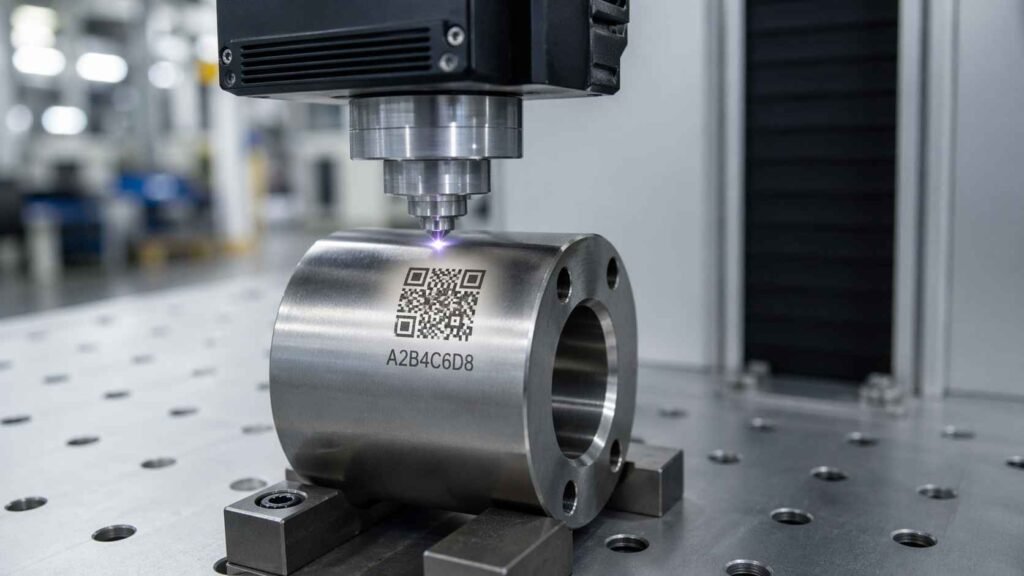
Why Metal Products Need Permanent QR Codes and Serial Numbers
Metal parts are often used in environments where ordinary labels, printed ink, or adhesive stickers may fail. Heat, oil, friction, cleaning, outdoor exposure, or mechanical handling can damage surface labels. Direct laser marking keeps the identification information on the part itself.
Common marking requirements include:
- QR codes for product information, maintenance records, or database access
- Data Matrix codes for compact industrial traceability
- Serial numbers for individual part identification
- Batch numbers for production and quality control
- Date codes for warranty and manufacturing records
- Barcodes for warehouse, assembly line, or inventory systems
- Logos and model numbers for brand and product recognition
For industrial buyers, code readability is often more important than appearance alone. A mark may look clear to the eye but still fail scanning if the contrast, code size, surface reflection, or marking depth is not properly controlled.
QR Code, Data Matrix, Barcode, and Serial Number: What Is the Difference?
Before choosing a marking solution, buyers should confirm what type of identification code is required. QR codes, Data Matrix codes, barcodes, and serial numbers are not used in exactly the same way.
| Marking Content | Common Use | Key Concern |
|---|---|---|
| QR Code | Product information, website access, service records, customer-facing traceability | Readable size, contrast, scanning distance, surface reflection |
| Data Matrix Code | Industrial part tracking, compact traceability, production control | Small module size, code quality, scanner compatibility |
| Barcode | Inventory, packaging, warehouse management, product identification | Line clarity, scan direction, available marking length |
| Serial Number | Individual part ID, warranty control, batch tracking, quality records | Variable data generation, numbering logic, duplicate prevention |
QR codes are useful when more data or customer-facing information is needed. Data Matrix codes are often preferred for small industrial parts because they can carry useful information in a compact space. Serial numbers are usually used together with QR codes or Data Matrix codes when each part requires a unique identity.
Why Fiber Laser Marking Is Common for Metal Traceability
Fiber laser marking is widely used for metal marking because it can produce fine, permanent, and high-contrast marks on many metal surfaces. Compared with inkjet printing or adhesive labels, laser marking does not require consumables and does not add extra material to the product surface.
A fiber laser marking machine is suitable for many metal identification tasks, including QR codes, serial numbers, barcodes, text, logos, and small graphics. For batch production, the marking software should support variable data, automatic numbering, date codes, barcode generation, QR code generation, and file import when needed.
Fiber laser marking is especially useful when the mark must remain attached to the part during storage, assembly, transport, cleaning, or long-term use. It is commonly used on stainless steel parts, aluminum components, tools, hardware, molds, electronic parts, medical hardware, automotive components, and industrial nameplates.
Laser Marking, Engraving, Annealing, and Ablation
Not every laser mark is made in the same way. The correct method depends on the material, surface treatment, required contrast, and service environment.
| Method | How It Works | Typical Use |
|---|---|---|
| Laser Marking | Changes the surface appearance with controlled laser energy | QR codes, serial numbers, barcodes, logos, product IDs |
| Laser Engraving | Removes material to create a deeper mark | Parts exposed to wear, abrasion, or harsh handling |
| Annealing Marking | Creates a color change on stainless steel without deep material removal | Stainless steel tools, medical parts, decorative metal surfaces |
| Ablation Marking | Removes coating, paint, oxide layer, or anodized layer | Anodized aluminum, coated nameplates, painted metal parts |
For QR codes and Data Matrix codes, deeper marking is not always better. A deep mark may help in abrasive conditions, but excessive depth can reduce edge clarity on small codes. For traceability codes, contrast, edge definition, and scanner readability usually matter more than depth alone.
Material and Surface Finish Affect Code Readability
Different metals react differently during laser marking. Even the same material can produce different results if the surface is polished, brushed, coated, anodized, oxidized, or oily. This is why sample testing should be done on the real part whenever possible.
| Material or Surface | Marking Consideration | Buyer Checkpoint |
|---|---|---|
| Stainless steel | Suitable for permanent text, serial numbers, QR codes, and Data Matrix codes | Check contrast, heat effect, and scanning under actual lighting |
| Aluminum | May need parameter adjustment for contrast, especially on bright surfaces | Confirm whether the surface is raw, anodized, coated, or polished |
| Anodized aluminum | Often marked by removing or changing the anodized layer | Check code contrast and surface appearance after marking |
| Carbon steel | Suitable for identification marks, deeper marks, and industrial codes | Confirm whether oil, coating, rust protection, or paint is present |
| Coated metal | Laser may remove coating to reveal the base layer | Test whether coating removal creates enough contrast |
| Polished metal | Reflection can affect scanning reliability | Test scanner performance from real working angles |
For stainless steel applications, buyers can also review how to choose a fiber laser marking machine for stainless steel parts before deciding the machine structure, fixture, and marking process.
Confirm QR Code and Data Matrix Code Size Before Production
Small codes are attractive because they save space, but they are not always reliable. The minimum workable code size depends on the amount of encoded data, module size, laser spot quality, surface condition, scanner type, and expected scanning distance.
Before confirming the code size, buyers should check:
- the amount of information encoded in the QR code or Data Matrix code
- the available marking area on the metal part
- whether the code will be scanned by a phone, handheld scanner, or industrial reader
- whether scanning happens indoors, outdoors, on an assembly line, or in a warehouse
- whether the surface is flat, curved, polished, brushed, coated, or anodized
- whether the mark must remain readable after cleaning, friction, or long-term use
For industrial traceability, it is better to test several code sizes before batch production. A slightly larger code with stable readability is usually better than a very small code that only scans under ideal conditions.
Variable Serial Number Marking Needs Stable Data Control
Serial number marking should not rely on manual editing for every part. In batch manufacturing, the marking software should support automatic serial number generation, date code generation, imported data, and production sequence control.
Common serial number formats include:
- simple sequence numbers, such as 000001, 000002, 000003
- date-based numbers, such as 20260424-001
- model-based numbers, such as ML-FM-50W-0001
- batch-based codes connected to production orders
- combined codes using model, date, batch, and sequence number
For production traceability, duplicate numbers, skipped numbers, or wrong codes can create quality control problems. Buyers should confirm whether the marking software can generate serial numbers automatically, import Excel or database files, and match the company’s production code rules.
Flat Parts, Round Parts, and Large Parts Need Different Setups
The marking result depends on part positioning as much as laser performance. A flat nameplate is easier to mark than a round pipe, shaft, valve body, tool handle, or large machine housing. If the part cannot be positioned consistently, the code may shift, distort, or scan poorly.
| Part Type | Recommended Setup | Reason |
|---|---|---|
| Flat nameplates and tags | Standard table with positioning guide | Easy repeat placement and stable focus |
| Small hardware parts | Custom fixture or multi-part tray | Improves batch consistency and reduces operator error |
| Pipes, shafts, rings, and tubes | Rotary marking device | Keeps curved surfaces aligned during marking |
| Large metal housings or equipment bodies | Portable marking setup | Useful when the part is too large or difficult to move |
| Mixed part sizes | Adjustable fixture and flexible marking template | Supports different product models in one workshop |
For large metal parts, assembled equipment, or products that cannot be easily placed under a standard marking head, a portable laser marking machine may be more practical than a fixed desktop setup.
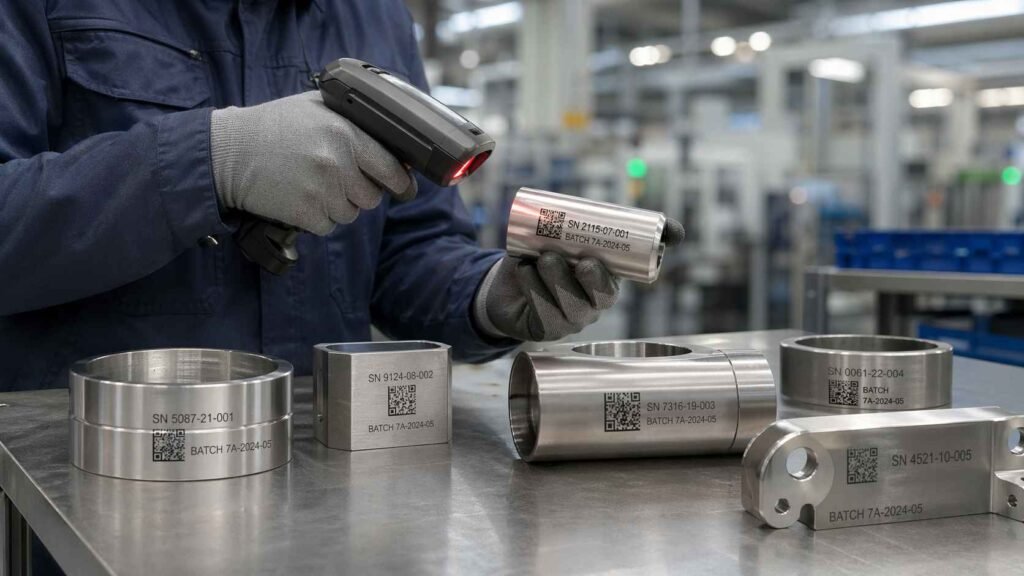
Industry Applications for Metal QR Code and Serial Number Marking
Metal traceability marking is used in many industries. The marking content may be similar, but the production requirement is often different.
| Industry | Typical Metal Parts | Common Marking Content |
|---|---|---|
| Automotive parts | Shafts, brackets, housings, engine-related parts | Serial numbers, Data Matrix codes, batch codes |
| Tools and hardware | Wrenches, blades, drill bits, hand tools, fixtures | Logo, model number, QR code, size marking |
| Machinery components | Frames, plates, covers, fittings, machined parts | Part number, production date, serial number, QR code |
| Electronics and electrical products | Aluminum shells, metal covers, connectors, panels | QR code, barcode, product ID, safety label information |
| Medical and precision hardware | Stainless steel tools, small devices, precision parts | Serial number, Data Matrix code, traceability code |
| Metal nameplates | Equipment plates, rating plates, identification tags | Text, barcode, QR code, model number, production data |
These applications usually require stable readability, repeatable positioning, and a marking process that can be integrated into daily production. For regular batch work, fixture design and software workflow may be as important as laser power.
How to Improve QR Code Scanning Reliability After Laser Marking
Scanning reliability should be checked before mass production. A code that scans once during testing may still fail if the angle, lighting, surface reflection, or part position changes during daily use.
To improve scanning reliability, buyers should pay attention to:
- proper code size for the amount of encoded data
- sufficient contrast between marked and unmarked areas
- clean module edges without excessive melting or blur
- stable focus height during marking
- consistent part positioning with fixture support
- scanner compatibility with QR code or Data Matrix code type
- testing under actual factory, warehouse, or field conditions
For critical traceability applications, scanning verification should be added after marking. This can help detect unreadable codes before parts move into assembly, packaging, or shipment.
Production Speed Depends on Code Complexity
Marking a short serial number is different from marking a dense QR code with multiple lines of text and a logo. Marking time depends on code size, code density, marking depth, material response, laser power, and required contrast.
Manufacturers should estimate:
- how many parts need to be marked per hour or per shift
- whether every part has a unique serial number
- whether the QR code or Data Matrix code changes for each part
- whether loading and unloading are manual or assisted by fixtures
- whether scanning verification is needed after marking
- whether the marking process is standalone or part of a production line
For low-volume work, a standard fiber laser marking setup may be enough. For repeated batch production, buyers should pay more attention to fixture design, software operation, operator workflow, and marking template management.
What to Send Before Requesting a Metal Laser Marking Quotation
A clear inquiry helps the supplier recommend a more suitable machine and reduces unnecessary back-and-forth. Instead of asking only for a general price, buyers should provide real application details.
| Information to Provide | Why It Matters |
|---|---|
| Metal material | Different metals require different marking parameters and contrast control |
| Surface condition | Polished, brushed, coated, or anodized surfaces affect readability |
| Part photos or drawings | Helps confirm marking position, fixture needs, and machine structure |
| Marking content | Confirms whether QR code, Data Matrix, barcode, serial number, logo, or text is needed |
| Code size and marking area | Affects scanning reliability, lens choice, and marking time |
| Daily production quantity | Helps evaluate marking speed and workflow requirements |
| Flat or curved surface | Determines whether a rotary device or custom fixture is needed |
| Scanning method | Helps control code contrast and verification expectations |
When the marking task involves stainless steel, aluminum, tools, hardware, nameplates, electronic shells, or industrial components, MADE Laser can recommend a suitable fiber laser marking setup based on sample details, marking content, and production requirements.
Conclusion
Marking QR codes and serial numbers on metal parts is not only a simple engraving task. The final result depends on material type, surface finish, code format, code size, contrast, fixture design, software data control, and scanning reliability.
Fiber laser marking is a practical method for permanent identification on many metal products, including stainless steel parts, aluminum components, tools, hardware, nameplates, machinery parts, and electronic housings. For production traceability, buyers should test the real material, confirm the required code format, and check scanner readability before batch marking.
For QR code, Data Matrix code, barcode, serial number, date code, or batch code marking on metal products, send part photos, material details, code size, marking position, and daily quantity to MADE Laser for a suitable machine recommendation.
FAQ
What machine is used to mark QR codes on metal parts?
A fiber laser marking machine is commonly used to mark QR codes on metal parts. It can create permanent, high-detail marks on stainless steel, aluminum, carbon steel, nameplates, tools, hardware, and other metal components. The final result depends on material, surface finish, code size, and scanning requirements.
Can fiber laser marking create serial numbers on stainless steel?
Yes. Fiber laser marking can create permanent serial numbers on stainless steel parts. It can also mark QR codes, Data Matrix codes, barcodes, logos, model numbers, and date codes when the marking software supports the required data format.
Is QR code or Data Matrix better for metal part traceability?
QR codes are useful for product information, service records, and customer-facing applications. Data Matrix codes are often preferred for compact industrial traceability because they can fit useful data into a smaller marking area. The better choice depends on available space, scanner type, and production system requirements.
How small can a laser-marked QR code be on metal?
The minimum size depends on encoded data, module size, laser spot quality, surface reflection, and scanner capability. A small code may be markable, but it should be tested on the actual metal part before batch production.
Does metal surface finish affect QR code scanning?
Yes. Polished, brushed, coated, anodized, or oily metal surfaces can affect contrast and reflection. For QR codes and Data Matrix codes, sample testing and scanner verification are important before confirming production parameters.
Can laser marking software generate changing serial numbers automatically?
Yes. Suitable laser marking software can generate serial numbers, date codes, barcodes, and QR codes automatically. It may also support imported data for batch production, helping reduce manual input errors and duplicate code risks.
When is a rotary device needed for metal serial number marking?
A rotary device is usually needed for round or cylindrical metal parts such as pipes, shafts, rings, tubes, and tool handles. It helps keep the marking area aligned so that serial numbers or codes remain clear and readable.