

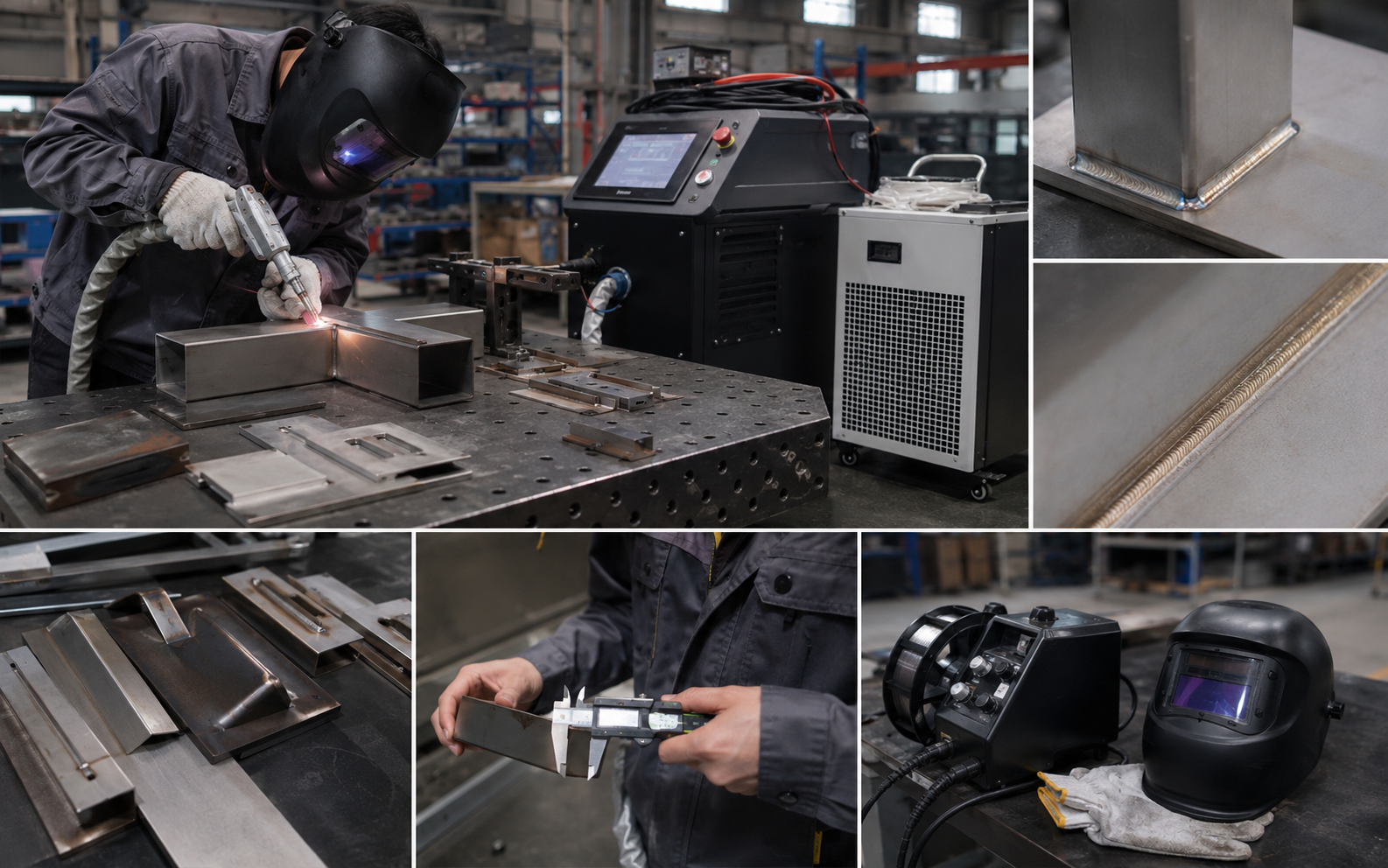
Choosing the right handheld laser welding machine requires more than comparing laser power or machine price.
For manufacturers, distributors and industrial buyers, the best welding solution depends on multiple factors, including material type, welding thickness, production requirements, workshop conditions and long-term service needs.
Compared with traditional welding methods, handheld laser welding technology provides advantages such as faster welding speed, cleaner weld appearance, lower heat distortion and easier operation. However, selecting an unsuitable configuration may affect welding quality, production efficiency and customer satisfaction.
This guide explains the key factors to consider before purchasing a
laser welding machine
and helps distributors recommend the right solution for different industrial applications.
Why More Manufacturers Choose Handheld Laser Welding Machines
Handheld laser welding machines have become increasingly popular in metal fabrication because they combine high welding quality with flexible operation.
Unlike traditional welding processes that often require complex preparation and skilled operators, handheld laser welders provide a more efficient solution for many small and medium-sized production applications.
The main advantages include:
- High welding speed for improved production efficiency
- Minimal heat affected area and reduced material deformation
- Cleaner weld seams with less post-processing
- Ability to weld various metal materials
- Lower skill requirements compared with some traditional welding methods
- Flexible operation for different workpieces
For companies producing stainless steel products, metal cabinets, machinery components, automotive parts or custom fabrication projects, handheld laser welding can significantly improve production flexibility.
1. Understand Your Welding Application Before Choosing a Machine
The first step when selecting a handheld laser welding machine is understanding the customer's actual application.
A suitable machine configuration should be based on production requirements rather than simply choosing the highest specification available.
Before requesting a quotation, buyers and distributors should confirm:
- Material type to be welded
- Required welding thickness
- Daily production volume
- Required welding speed
- Appearance requirements of the finished weld
- Available workshop space
- Local electrical conditions
- Operator experience level
For example, a stainless steel kitchen equipment manufacturer may have different requirements compared with an automotive component supplier.
The recommended laser power, cooling system and welding configuration may therefore be different.
2. Select the Appropriate Laser Power
Laser power is one of the most important specifications when purchasing a handheld laser welding machine.
However, higher power does not always mean a better solution.
The correct power level depends mainly on:
- Material thickness
- Material type
- Required penetration depth
- Production efficiency requirements
- Continuous working time
Common handheld laser welding power options include 1000W, 1500W, 2000W and higher configurations.
The final selection should match the customer's daily production requirements.
For example:
- Lower power configurations may be suitable for thinner stainless steel sheets and light fabrication work.
- Medium power machines can provide a balance between welding capability and investment cost.
- Higher power systems are suitable for thicker materials and applications requiring deeper penetration or higher productivity.
A professional supplier should evaluate the customer's materials and applications before recommending the final configuration.
3. Air-Cooled vs Water-Cooled Handheld Laser Welding Machines
The cooling system directly affects machine stability, working environment requirements and maintenance considerations.
There are two common cooling solutions:
Air-Cooled Handheld Laser Welding Machine
Air-cooled systems are designed for customers who need a more compact and flexible welding solution.
Without a traditional external water chiller, the equipment layout can be simpler and easier to move.
This type of solution can be suitable for:
- Small workshops
- Flexible production environments
- On-site repair applications
- Projects requiring easier equipment mobility
You can learn more about this configuration through our
air-cooled handheld laser welding machine
.
Water-Cooled Handheld Laser Welding Machine
Water-cooled systems are commonly selected for applications requiring longer continuous operation or higher production stability.
The cooling unit helps maintain stable operating conditions during extended welding processes.
For industrial production environments with long working hours, a water-cooled solution may provide better thermal management.
4. Consider Materials and Welding Thickness
Different metals have different welding characteristics.
A machine that performs well on stainless steel may require different parameters when processing aluminum, carbon steel or other alloys.
Common materials for handheld laser welding include:
- Stainless steel
- Carbon steel
- Galvanized steel
- Aluminum alloys
- Brass and other metal alloys
Before purchasing, distributors should collect actual samples or drawings from customers whenever possible.
Testing representative workpieces helps confirm welding quality and suitable parameters.
5. Handheld Laser Welding Machine Applications
Handheld laser welding machines are widely used in industries that require flexible metal joining and high-quality weld appearance.
Typical applications include:
- Stainless Steel Fabrication:
Kitchen equipment, tanks, cabinets and customized stainless steel products. - Sheet Metal Manufacturing:
Electrical enclosures, metal frames and industrial components. - Automotive Parts:
Metal brackets, components and repair applications. - Machinery Manufacturing:
Machine frames, covers and structural parts. - Metal Furniture Production:
Furniture frames and decorative metal structures.
6. Evaluate Important Machine Components
A handheld laser welding machine is a complete system consisting of multiple components.
When comparing suppliers, buyers should evaluate the complete configuration instead of focusing only on the laser source.
Important components include:
- Laser source
- Welding head
- Control system
- Cooling system
- Wire feeding system
- Electrical components
- Safety protection functions
The quality of machine integration, assembly and technical support also influences long-term performance.
7. Handheld Laser Welding Machine vs Robotic Laser Welding Machine
Handheld and robotic laser welding systems serve different production requirements.
Handheld laser welding is usually preferred for:
- Flexible production
- Multiple workpiece types
- Small and medium production batches
- Manual operation environments
Robotic laser welding is more suitable for:
- High-volume production
- Repeated welding tasks
- Automated manufacturing lines
- Consistent production processes
For customers requiring automation, distributors can also evaluate our
robotic laser welding machine
solutions.
8. Questions to Ask Before Buying From a Laser Welding Supplier
Before placing an order, distributors should confirm the following information with suppliers:
- What materials can the machine weld?
- What thickness range can it handle?
- What cooling system is recommended?
- What accessories are included?
- Are spare parts available?
- Is operator training provided?
- What after-sales support is available?
- Can the supplier provide welding tests?
A reliable supplier should provide not only equipment but also technical guidance during machine selection, installation and operation.
9. How to Choose a Reliable Handheld Laser Welding Machine Manufacturer
For distributors, choosing the right manufacturer is as important as choosing the right machine.
A long-term supplier relationship requires stable quality, technical support and reliable communication.
Important evaluation factors include:
- Product range and customization capability
- Manufacturing experience
- Quality control process
- Export experience
- Documentation support
- Spare parts supply
- Technical response speed
MADE Laser provides laser welding solutions for industrial customers and distributors, including handheld and automated welding equipment.
You can explore our
laser welding machine products
for different applications.
Request a Laser Welding Machine Quotation →
FAQ: Handheld Laser Welding Machine
What materials can a handheld laser welding machine weld?
Handheld laser welding machines can commonly process stainless steel, carbon steel, galvanized steel, aluminum alloys and other metal materials.
The final capability depends on material type, thickness and machine configuration.
Is a handheld laser welder suitable for industrial production?
Yes. Handheld laser welders are widely used in metal fabrication, machinery manufacturing, stainless steel processing and other industrial applications.
How do I choose the right laser welding power?
The recommended power depends on material thickness, production requirements and required welding performance.
A supplier should evaluate the application before recommending a configuration.
What is the difference between handheld and robotic laser welding?
Handheld systems provide flexibility for various workpieces, while robotic systems are designed for repetitive high-volume automated production.
What information should I provide when requesting a quotation?
Provide material type, thickness, application, production volume, destination country and preferred machine requirements.
This allows the supplier to recommend a suitable solution.