

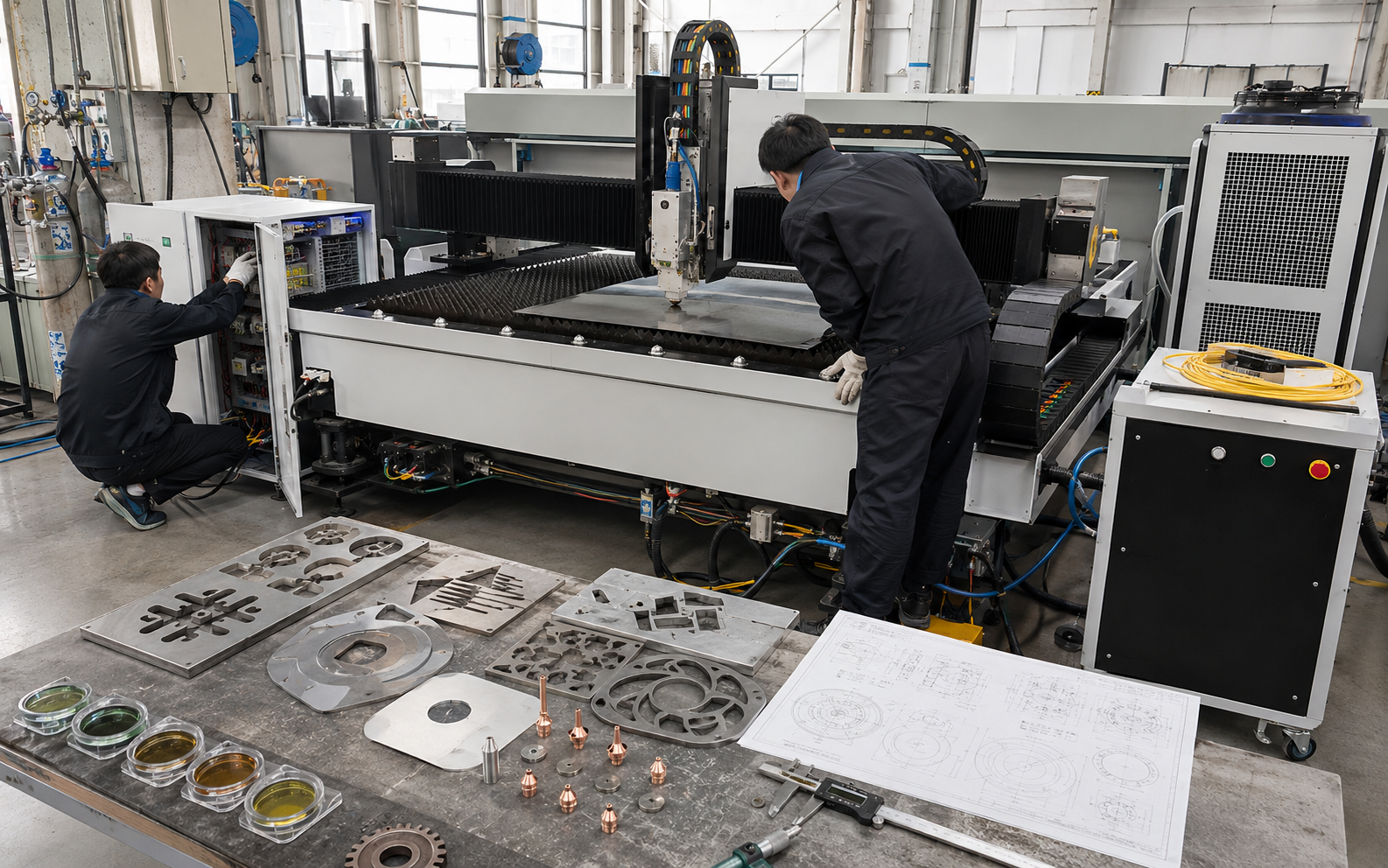
For a laser equipment distributor, selecting a fiber laser cutting machine is not simply a matter of choosing a higher laser power.
The right configuration depends on the customer's material, thickness range, production volume, sheet size, workshop conditions,
automation requirements and expected operating cost.
A machine that is oversized for the application may increase investment without creating enough additional value.
A machine that is underspecified can create cutting limitations, slower production and unnecessary after-sales problems.
For distributors, matching the machine configuration to the actual application is therefore an important part of both sales and long-term customer support.
This guide explains the main factors distributors should evaluate before requesting a quotation or recommending a
fiber laser cutting machine
to an end user.
1. Start With the Customer's Cutting Requirements
Before discussing machine models, distributors should collect basic information about the customer's production.
This allows the manufacturer to recommend a configuration based on the real application instead of quoting a standard machine with insufficient context.
The most important questions include:
- What materials will be cut?
- What is the minimum and maximum sheet thickness?
- What sheet dimensions are commonly processed?
- What is the normal production volume?
- How many hours will the machine operate each day?
- Does the customer process repetitive batches or frequently changing jobs?
- How much workshop space is available?
- What electrical supply is available at the installation site?
- Which assist gases can the customer access locally?
- Is an open machine acceptable, or is a fully enclosed system preferred?
For example, a small fabrication workshop processing varied sheet-metal jobs may prioritize investment cost and flexibility,
while a production factory cutting similar components throughout the day may place more importance on loading efficiency and continuous production.
Collecting this information before the quotation stage also helps distributors compare proposals from different manufacturers on an equal basis.
2. Choose the Worktable Structure According to Production Volume
The worktable structure has a direct influence on machine footprint, loading workflow, productivity and investment.
Three common configurations are particularly relevant to sheet-metal customers.
Single Table Fiber Laser Cutting Machine
A single-table machine provides a comparatively straightforward layout and is often suitable for workshops that do not require continuous exchange-table production.
It can be a practical choice for customers entering fiber laser cutting, companies with limited floor space and job shops processing mixed orders.
Distributors serving these customers can review the
Single Table Fiber Laser Cutting Machine
to understand the type of machine architecture available for this application.
Double Worktable Fiber Laser Cutting Machine
For customers with higher production requirements, an exchange-table system can reduce non-cutting time.
While one table is inside the cutting area, operators can load raw sheet or remove finished components from the other table.
This configuration is particularly relevant for production-oriented sheet-metal factories where machine utilization and loading efficiency affect overall output.
The
Double Worktable Laser Cutting Machine
provides an example of this type of production layout.
Enclosed Double Worktable Machine
Customers may also require a more enclosed machine structure because of their internal safety policies, workshop management requirements,
production environment or preference for a more isolated cutting area.
For these applications, distributors can evaluate an
Enclosed Dual Worktable Laser Cutting Machine
rather than automatically recommending an open system.
| Customer Requirement | Typical Configuration to Evaluate |
|---|---|
| Flexible production and controlled investment | Single table |
| Higher loading and cutting efficiency | Double worktable |
| High production with enclosed cutting area | Enclosed double worktable |
These are application guidelines rather than fixed rules.
Distributors should always confirm the customer's production process before finalizing the machine structure.
For a more detailed comparison, see our
single table vs double worktable fiber laser cutting machine guide.
3. Do Not Select Laser Power by Wattage Alone
Laser power is one of the first specifications buyers compare, but higher wattage does not automatically mean a better machine for every customer.
The correct power level should be evaluated together with:
- Material type
- Maximum production thickness
- Normal production thickness
- Required cutting speed
- Required edge quality
- Assist gas
- Production volume
- Expected operating cost
A distributor should distinguish between a customer's occasional maximum-thickness requirement and the thickness they process every day.
Designing an entire machine specification around an uncommon job can result in unnecessary investment.
Likewise, selecting insufficient power to reduce purchase price may create a machine that technically performs the job but does not meet the customer's expected production speed.
When requesting a configuration from a manufacturer, provide several representative cutting conditions rather than simply asking:
"What is the price of a fiber laser cutting machine?"
A better RFQ looks like this:
- Material: carbon steel and stainless steel
- Normal thickness range: specify the customer's actual range
- Maximum thickness: specify separately
- Sheet dimensions: actual production sheet size
- Daily operating time: expected hours per shift
- Primary objective: speed, flexibility, cost control or production capacity
This gives the engineering and sales team enough information to recommend a more appropriate solution.
4. Evaluate the Cutting Head and Optical System
The cutting head works directly in the production environment and should not be treated as a secondary component.
Distributors should understand how the selected cutting head matches the laser source, required power level and intended materials.
Important points to discuss with the manufacturer include:
- Supported laser power
- Automatic focusing capability
- Protective lens design
- Optical sealing
- Focus adjustment
- Replacement procedure for consumable components
- Availability of spare protective lenses and related parts
- Technical support when cutting quality changes
For distributors, maintainability is particularly important.
A component that is difficult to service may create a much larger support burden after machines are installed in different customer locations.
5. Pay Attention to the Machine Bed and Motion System
A fiber laser cutter is a complete motion system, not only a laser source.
Long-term cutting performance also depends on the machine bed, beam, guide system, drive system and assembly quality.
When evaluating a supplier, distributors should ask how major structural components are manufactured and processed.
Useful questions include:
- How is the machine bed welded and stress relieved?
- How are major structural parts machined?
- How is machine geometry checked during assembly?
- Which guide rails, reducers and servo systems are used?
- How is positioning accuracy verified before shipment?
- Is a cutting test performed before delivery?
These questions provide more useful information than comparing component brand lists alone.
Two machines containing similar purchased components can still perform differently if their mechanical manufacturing,
assembly and commissioning processes are different.
6. Confirm Assist Gas and Compressed Air Requirements
Assist gas is an important part of fiber laser cutting performance and operating cost.
Depending on the material and required edge condition, customers may use oxygen, nitrogen or properly prepared compressed air for suitable applications.
The available gas infrastructure should therefore be discussed before the order is finalized.
A distributor should determine:
- Which gases are readily available in the customer's market?
- What gas pressure is required for the proposed application?
- Does the customer already have an air compressor?
- Is the compressed air sufficiently dry and clean?
- Are dryer and filtration systems required?
- What will the approximate gas consumption mean for operating cost?
Compressed air quality is particularly important because moisture and contamination can affect the pneumatic and optical systems.
Utility preparation should therefore be treated as part of machine installation rather than something considered after delivery.
7. Check Electrical and Site Conditions Before Shipping
A common distributor problem occurs when the machine reaches the customer before the installation conditions have been fully confirmed.
Electrical voltage, frequency, grounding, floor condition, ventilation, ambient environment,
air supply and available working space should all be checked during the quotation or pre-shipment stage.
For example, MADE Laser's current double worktable product information includes requirements relating to three-phase power,
dry filtered compressed air, grounding, floor conditions and machine installation environment.
The exact requirements should still be confirmed for the final configuration before shipment.
This is especially important for distributors selling into multiple countries because electrical standards and factory conditions can vary between markets.
8. Consider Maintenance Before the Machine Is Sold
For a distributor, the easiest machine to sell is not always the easiest machine to support.
Service requirements should therefore be considered during configuration selection.
Before purchasing, confirm:
- Which parts are considered consumables?
- Which spare parts should be stocked locally?
- How quickly can replacement components be supplied?
- What maintenance tasks can the customer's operator perform?
- Which faults require manufacturer support?
- Is remote troubleshooting available?
- Are operating and maintenance documents supplied?
A preventive maintenance plan can reduce avoidable downtime and also make after-sales communication easier for distributors.
Our
fiber laser cutting machine maintenance checklist
covers daily, weekly and periodic inspection points that can be discussed with customers before machine delivery.
9. Compare Suppliers by the Complete Machine, Not the Quotation Price
When quotations from several fiber laser cutting machine manufacturers arrive, the lowest total price can be attractive.
However, distributors should first determine whether the quotations include equivalent configurations and support.
Compare at least the following:
- Laser source specification
- Cutting head configuration
- Machine dimensions and working area
- Single or exchange worktable design
- Servo and transmission system
- Water chiller
- Electrical configuration
- Dust extraction requirements
- Included accessories
- Consumables supplied with the machine
- Installation support
- Training
- Warranty conditions
- Spare-parts availability
- Shipping scope and packaging
A quotation that appears cheaper may simply exclude components or services included in another offer.
Creating a standardized comparison sheet makes supplier evaluation more accurate.
If you are still evaluating manufacturing partners rather than individual configurations,
read our
fiber laser cutting machine supplier guide for distributors,
which focuses on supplier qualification, documentation, support and long-term cooperation.
10. Build a Standard RFQ Template for Your Distribution Business
Distributors handling repeated inquiries can improve quotation speed by using the same RFQ structure for every customer.
A useful fiber laser cutting machine RFQ should contain:
- Country: Installation destination
- Material: Carbon steel, stainless steel, aluminum or other metals
- Normal thickness: Most frequently processed range
- Maximum thickness: Occasional upper requirement
- Sheet size: Standard raw material dimensions
- Production type: Job shop, batch production or continuous manufacturing
- Working hours: Estimated daily machine usage
- Preferred layout: Single table, double worktable or enclosed system
- Power supply: Local voltage and frequency
- Assist gas: Available nitrogen, oxygen or compressed-air system
- Application samples: Drawings or photos when available
- Required delivery date: Target project schedule
Sending this information at the beginning of the project reduces repeated communication and allows the manufacturer to prepare a more relevant technical proposal.
Common Configuration Mistakes Distributors Should Avoid
Choosing the Highest Power Without Studying the Application
More power may increase capability, but it can also increase investment and supporting equipment requirements.
The selected power should solve the customer's actual production problem.
Ignoring Loading and Unloading Time
For customers with significant production volume, machine utilization can be affected by material handling.
In these situations, worktable structure can be just as important as cutting speed.
Focusing Only on Major Component Brands
Component brands matter, but mechanical manufacturing, assembly, commissioning and technical support also influence the long-term user experience.
Confirming Utilities After the Machine Has Shipped
Electrical supply, grounding, compressed air, gas and workshop conditions should be checked before production and shipping arrangements are finalized.
Not Planning Spare Parts
Distributors should identify commonly required consumables and service parts before installing the first machine in a market.
Local availability can significantly simplify after-sales support.
How Distributors Can Work With MADE Laser
For distributors, a useful supplier relationship starts before the machine is ordered.
Providing clear application information allows both sides to discuss the configuration from a technical and commercial perspective.
You can first explore our
fiber laser cutting machine range
and compare available machine structures.
You can also learn more about
MADE Laser
before starting a distributor or project discussion.
When requesting a quotation, send us the customer's material, thickness range, sheet size,
production requirement, local voltage and destination country.
Our team can then discuss a suitable machine configuration based on the application.
Contact MADE Laser for a Fiber Laser Cutting Machine Configuration and Quotation →
FAQ: Fiber Laser Cutting Machine Configuration
What information should a distributor provide before requesting a fiber laser cutting machine quotation?
Provide the customer's material, normal and maximum thickness, sheet size, production volume,
daily operating time, local voltage, available assist gas and destination country.
Drawings or representative workpieces can also help the manufacturer understand the application.
Should I recommend a single-table or double-worktable laser cutting machine?
A single-table system can suit flexible production, controlled investment and lower production volume,
while a double-worktable system can help reduce loading and unloading interruptions in higher-throughput production.
The final selection should depend on the customer's actual workflow.
Is higher laser power always better?
No. Laser power should be selected according to material, thickness, required cutting speed,
edge quality and production volume. Buying substantially more power than the application requires may increase investment without providing proportional value.
What should distributors compare when evaluating different quotations?
Compare the complete machine configuration, including the laser source, cutting head, machine structure,
motion system, chiller, accessories, installation scope, warranty, training and spare-parts support rather than comparing price alone.
Why are installation conditions important?
Fiber laser cutting machines require suitable electrical power, grounding, assist gas or compressed air,
ventilation and appropriate workshop conditions. Confirming these requirements before shipping can prevent installation delays.
Can MADE Laser help recommend a configuration for my customer?
Yes. Send the application requirements through our
contact page,
including material, thickness range, sheet size, production needs, local voltage and destination.
This information can be used to discuss an appropriate fiber laser cutting machine configuration.