

For thin sheet metal work, the comparison between handheld laser welding and TIG usually comes up sooner or later.
Both processes are widely used. Both can produce acceptable results. But they do not always fit the same production needs, and they do not create the same shop-floor rhythm. That is where the decision usually starts.
The better choice is rarely about theory alone. It comes down to the parts being welded, the finish expected after welding, and how much labor the shop wants tied up in the process.
Thin Sheet Metal Leaves Less Room for Error
Thin sheet parts tend to show process problems quickly.
Too much heat, uneven seams, extra polishing, or visible distortion can all turn into production issues, especially on stainless products, visible outer panels, cabinets, covers, furniture parts, and other light fabrication work.
That is why many shops do not judge the welding process only by whether it can complete the joint. They also look at how much follow-up work the weld creates.
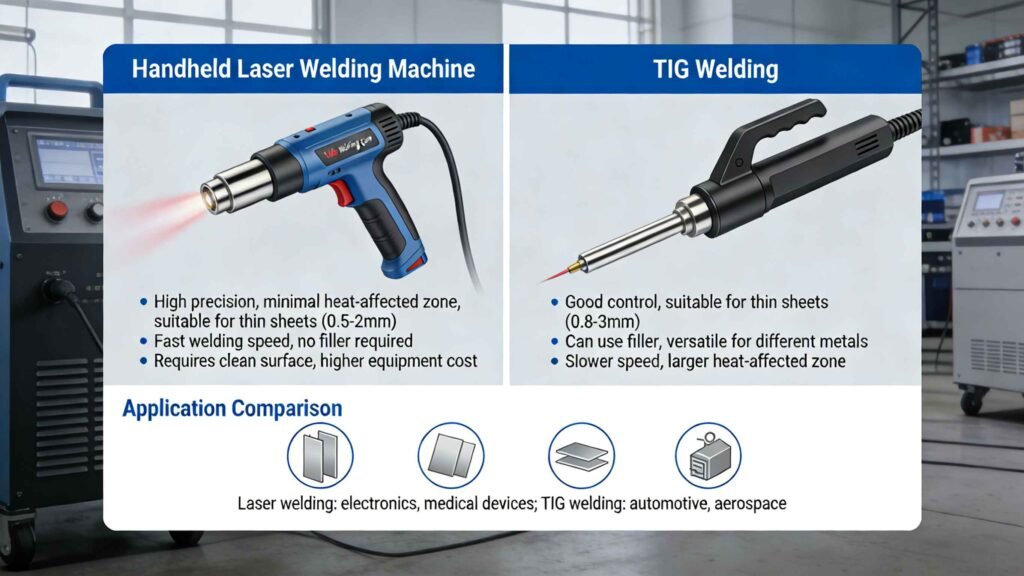
Why TIG Is Still Common
TIG welding is familiar, proven, and already built into many fabrication shops.
Operators know it. Existing jobs may already be set up around it. For some factories, that alone is reason enough to keep using it.
And in plenty of cases, TIG still works well enough. Not every production line needs to change just because another process is available.
Still, when buyers compare TIG with a handheld laser welding machine for thin sheet metal, they are usually trying to improve one or more of these points:
- welding speed
- seam consistency
- post-weld grinding
- visible finish
- operator dependence
- training efficiency
That is the real comparison.
Where Handheld Laser Welding Often Makes Sense
In suitable thin sheet applications, a handheld laser welding machine can make the overall welding process easier to control.
That does not only mean the weld itself. In many shops, the bigger gain is what happens after the weld. Less rework, less grinding, and a cleaner seam can change the total labor involved in making the part.
This is one reason handheld fiber laser welding machines are often considered for:
- stainless steel sheet parts
- cabinets and enclosures
- kitchen equipment
- decorative metal work
- furniture frames
- light fabrication assemblies
Where finish quality matters and the same kind of joint is repeated throughout the day, the process advantage can be practical, not just technical.
Why Some Shops Still Stay with TIG
TIG is not automatically the wrong choice.
A shop may stay with TIG because the current workflow is stable, the operator team is experienced, and the production volume does not justify a change in equipment. In some cases, the existing method already does the job well enough.
That is why this comparison should not be reduced to “laser is newer” or “TIG is traditional.” The better question is whether changing the process actually improves production results in a measurable way.
Compare by Product Type, Not by Marketing Claims
The value of handheld laser welding depends heavily on the product.
A decorative stainless cover, a light-gauge cabinet part, and a simple structural sheet component may all be thin metal, but they are not judged the same way in production. One may be appearance-driven. Another may be speed-driven. Another may be limited more by fitting and fixture quality than by the welding process itself.
A practical comparison should look at:
- material type
- thickness range
- seam visibility
- output target
- polishing workload
- operator arrangement
- current defect or rework level
Without that, the comparison stays generic and does not help much with equipment selection.
Total Efficiency Is More Than Weld Speed
This point gets missed often.
When shops compare handheld laser welding with TIG, they sometimes focus only on how fast the weld is made. But real production efficiency also includes setup rhythm, operator movement, correction work, grinding, and consistency from one part to the next.
In some thin sheet jobs, the biggest gain is not the arc-on time. It is the reduction in finishing work afterward.
That is often where the return shows up.
How to Evaluate the Change
If a shop is seriously comparing TIG and handheld laser welding for thin sheet metal work, it helps to evaluate the process using real jobs instead of general assumptions.
Useful points to review include:
- material and thickness
- joint type
- visible seam requirement
- daily quantity
- current grinding time
- defect or rework rate
- operator availability
- power supply conditions
Once those points are clear, it becomes much easier to judge whether a handheld laser welder is a sensible upgrade or whether the current TIG process is still sufficient.
Conclusion
The choice between handheld laser welding machine and TIG welding for thin sheet metal work is not just about welding method. It is a production decision.
For stainless steel sheet parts, cabinets, decorative metal products, and light fabrication work, the right process depends on finish requirements, labor arrangement, production target, and how much post-weld work the shop is willing to carry.
If you are comparing handheld laser welding and TIG for your current sheet metal products, send your material, thickness range, weld photos, and daily output target. That makes it easier to judge which process fits the job more effectively.
FAQ
Is a handheld laser welding machine better than TIG for thin stainless steel?
In some applications, yes, especially where cleaner seam appearance and less post-weld finishing are important. The better choice still depends on the product and workflow.
Does TIG still make sense for thin sheet metal fabrication?
Yes. Many shops continue using TIG because the process is familiar, stable, and already fits their production needs.
What should be compared before switching from TIG to laser welding?
Material, thickness, seam requirement, output volume, grinding workload, operator situation, and current rework level are all worth checking.
Is post-weld grinding usually lower with handheld laser welding?
In many suitable applications, it can be. Actual results still depend on joint preparation, fitting accuracy, and process setup.
What should be sent to a supplier for process evaluation?
Product photos, drawings, material type, thickness range, joint type, and the current welding process are all useful.