

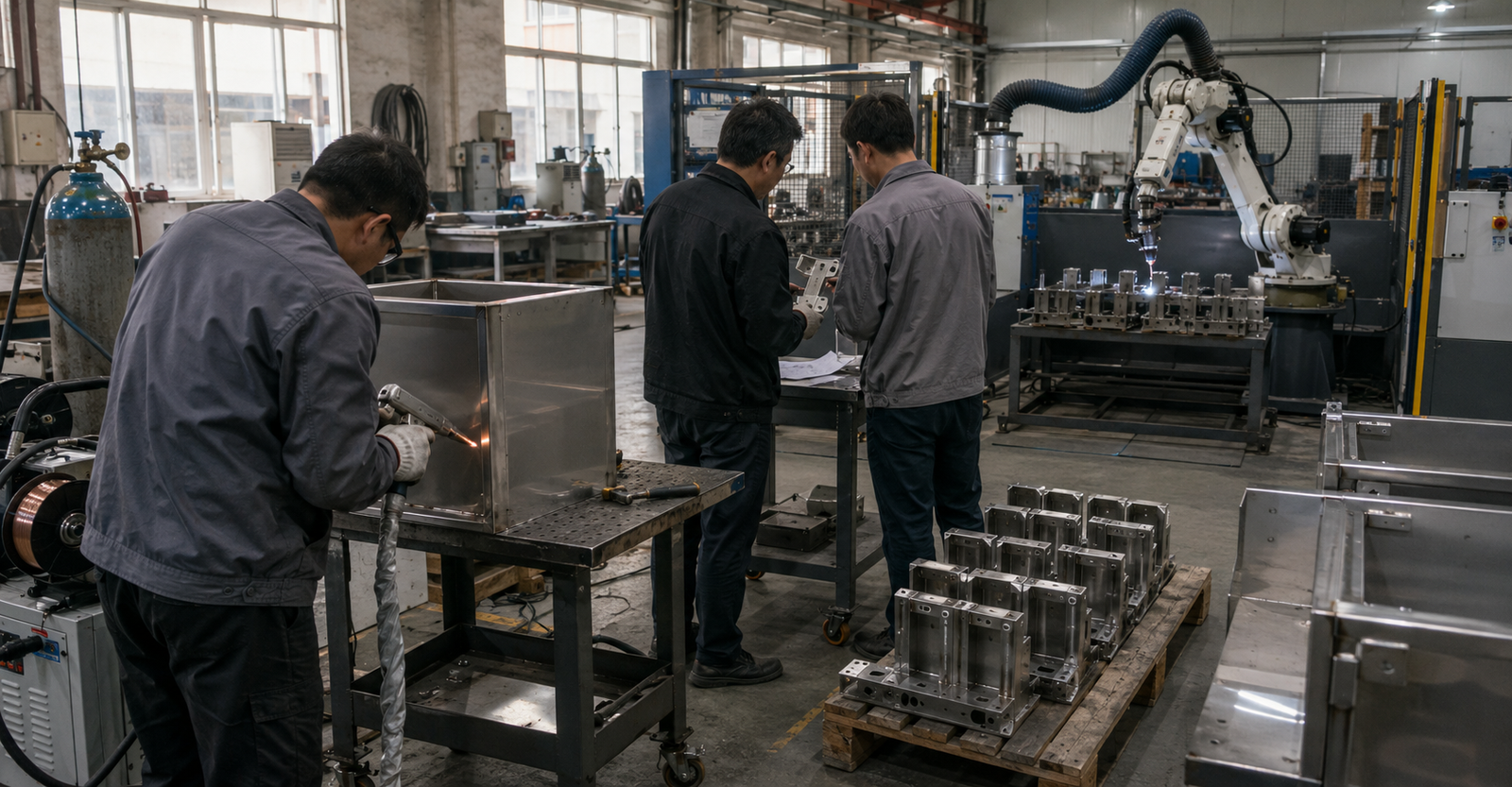
What Is a Handheld Laser Welding Machine?
A handheld laser welding machine uses a portable welding gun operated manually along the joint. It is suitable for factories processing different products, irregular components, large workpieces or small and medium production batches.
Buyers can review the
MADE Laser handheld laser welding machine
for available configurations and application information.
Main Advantages
- Flexible for different product sizes and welding positions
- Suitable for customized and small-batch production
- Lower initial investment than a robotic welding cell
- Requires less floor space and automation equipment
- Can reduce grinding and finishing in suitable applications
- Easier to introduce into an existing metal workshop
Typical Applications
- Stainless steel cabinets
- Commercial kitchen equipment
- Metal doors and windows
- Electrical enclosures
- Metal furniture
- Custom sheet-metal products
- Repair and maintenance work
What Is a Robotic Laser Welding Machine?
A robotic laser welding machine combines a fiber laser source with an industrial robot, welding head, fixture and control system. The robot follows a programmed path to weld repeated parts with consistent movement.
Buyers planning an automated production project can review the
MADE Laser robotic laser welding machine
.
Main Advantages
- Repeatable welding paths
- Stable production cycle
- Suitable for medium- and high-volume production
- Reduced dependence on manual gun movement
- Can be integrated with fixtures, positioners and production lines
- Suitable for standardized parts and repeated seams
Typical Applications
- Automotive supporting components
- Metal brackets and frames
- Appliance components
- Standard electrical enclosures
- Machinery parts
- Hardware products
- Repeated batch production
Handheld vs Robotic Laser Welding Machine
| Comparison | Handheld Laser Welder | Robotic Laser Welder |
|---|---|---|
| Production type | Customized and changing products | Standardized batch production |
| Workpiece flexibility | High | Depends on programming and fixtures |
| Welding movement | Controlled by the operator | Controlled by the robot |
| Repeatability | Depends partly on operator skill | More consistent for repeated parts |
| Initial investment | Lower | Higher |
| Fixture requirements | Basic or application-dependent | Stable fixtures are important |
| Floor space | Generally smaller | Generally larger |
| Best suited for | Flexible metal fabrication | Continuous automated production |
Which Laser Welding Machine Should You Choose?
Choose a Handheld Laser Welder When:
- Your products change frequently
- You process customized or irregular workpieces
- Production volume is low or medium
- You need to weld large assembled products
- Workshop space or budget is limited
- You need a flexible alternative to conventional manual welding
Choose a Robotic Laser Welder When:
- You produce repeated standardized parts
- Daily production volume is high
- Joint positions and workpiece dimensions are consistent
- You require stable welding paths and cycle times
- Your factory already uses fixtures or automated production equipment
- You plan to integrate welding into a larger production line
Important: A robotic system can repeat a programmed path, but it still requires consistent parts, controlled joint gaps and reliable fixtures.
Other Factors Equipment Buyers Should Confirm
Whether choosing a handheld or robotic machine, buyers should confirm the complete technical configuration before comparing prices.
- Material type and thickness range
- Joint type and maximum joint gap
- Required laser power
- Laser source and welding head
- Wire feeder configuration
- Cooling method
- Local voltage and frequency
- Daily working hours
- Training and commissioning
- Warranty and spare-parts support
For handheld systems, read the
1500W vs 2000W vs 3000W laser welding machine guide
before selecting power.
Buyers comparing compact and traditional cooling systems can also read
air-cooled vs water-cooled handheld laser welding machines
.
Information Needed for an Accurate Quotation
To receive a suitable machine recommendation, provide the following information:
- Product photographs or drawings
- Material and material grade
- Normal and maximum thickness
- Joint type and joint gap
- Part dimensions and weight
- Required weld appearance
- Parts produced per shift
- Number of product models
- Daily operating hours
- Local power supply
- Destination country
Final Recommendation
A handheld laser welding machine is the better choice for flexible production, customized workpieces and easier equipment adoption.
A robotic laser welding machine is more suitable for repeated parts, stable batch production and factories planning automated welding.
The best machine is not always the most automated option. It is the system that matches your actual products, output and production workflow.
Request a Laser Welding Machine Recommendation
Send MADE Laser your workpiece drawings, material, thickness, daily output, local voltage and destination. Our team will recommend a suitable handheld or robotic laser welding solution.
Frequently Asked Questions
Is robotic laser welding always better?
No. Robotic welding is better suited to repeated parts, while handheld welding offers greater flexibility for changing products and customized work.
Which machine requires a lower investment?
A handheld laser welding machine normally requires a lower initial investment because it does not need an industrial robot, automation cell and complex fixtures.
Can a handheld laser welder be used for batch production?
Yes. It can be used for batch production when the required output can be completed efficiently and operators follow standardized welding procedures.
What should I send before requesting a quotation?
Send workpiece drawings, material, thickness, joint details, daily output, voltage and destination. These details help the supplier recommend the correct machine.